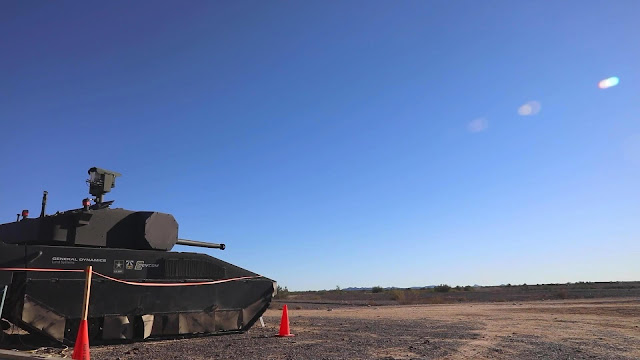
PICATINNY ARSENAL, N.J. -- After a successful live-fire test of the Army’s Extended Range Cannon Artillery (ERCA) limited-capacity autoloader at Yuma Proving Ground in June 2019, the Picatinny engineers who developed it have refined a faster autoloader and have succeeded in conducting its initial trials here, December 15-22.
Development of the ERCA autoloader capability is notable because it would enable the cannon to fire at significantly faster rates, enhance lethality, and it may set the stage for future “optionally manned” artillery battery configurations where fewer – or possibly no Soldiers – would be required at the cannon during firing operations.
ERCA from the turret bearing up is a 100-percent Armaments Center-developed system. The ERCA armament and munitions have been thought about and innovation applied to them by the engineers at the Armaments Center for the XM1299, which gets’ you the range, and XM1299E1, which gets you the rate of fire capability.
The ERCA effort is nested within the Army’s top Modernization Priority, Long Range Precision Fires (LRPF). The Long Range Precision Fires Cross Functional Team (CFT) has set plans in motion for a two phased capability improvement by first providing the Soldier a self-propelled howitzer with increased range, followed by an increase to rate-of-fire. The U.S. Army Combat Capabilities Development Command (DEVCOM) Armaments Center at Picatinny Arsenal, N.J., is leading the ERCA design effort.
Cannon loading requires selecting the right type of projectile and fuze to deliver the desired effect to the target and selecting the right propellant to match the required distance. First, the fuze is set. Next, the projectile and then the charge are loaded into the cannon’s tube, the breech is closed and the cannon is ready to fire.
The autoloader is a machine that performs these well-orchestrated tasks, which have historically been performed by cannon crew members. The autoloader, however, can attain a rate of fire that is 2-3 times faster than a cannon crew, with limits to duration such as the cannon tube overheating, according to Armaments Center Project Engineer and ERCA Ammunition Handling System Lead, Jimmy Lee.
In November 2018, an earlier variant of the ERCA, the XM1299 howitzer, fired projectiles out to 72 kilometers at Yuma, the farthest-reaching shots ever made by U.S. Army howitzers, and more than double the reach of currently fielded Army artillery systems.
In the demonstration in June 2019, an early science and technology ERCA prototype outfitted with a limited capacity autoloader, loaded five mass simulator high velocity projectiles and five prototype XM657 Extended Range Supercharge propellant charges, and successively fired a five-round cannon “burst” downrange at a rate of seven-rounds-per-minute. The purpose of the demonstration was to inform development of the ERCA XM1299E1 according Armaments Center Project Officer for ERCA, Josiah Fay.
The limited capacity autoloader was designed to handle only one type of projectile and charge, and it worked with a limited capacity magazine, according to Lee. It was built to validate key aspects of the engineering approach during the march toward the objective autoloader, and the tests allowed the team to verify that key components would work as intended in realistic conditions, while close observation of its performance would inform future autoloaders.
Next up, according to Lee, was building and demonstrating the objective capacity autoloader, which will be able to load and manage a suite of the Army’s legacy and emerging fuzes, propellant charges and projectiles, and it will work with larger capacity magazines. It is a more complex machine because projectiles, fuzes and propellant charges come in different shapes, sizes, and weights, which requires the autoloader to handle a range of configurations to execute a fire mission.
Also, the newer autoloader must deliver at a higher rate while working in synchronization with the larger magazines, which store and manage the loads so that it will deliver the right combination of fuze, projectile and propellant for the fire mission.
The Armaments Center engineers are working at Picatinny with an industry partner via an Other Transaction Agreement contract vehicle to attain the desired ammunition handling capability. The industry partner develops the magazines while working in coordination with the Armaments Center’s autoloader development team.
The Autoloader and Other ERCA Objectives
The ERCA system’s development emerged as a formal research effort – known as a “STO” for Science and Technology Objective – following a 2013 study that assessed next-generation artillery. According to Lee, the main takeaway from the onset of the effort was that significantly increased range coupled with increased rates of fire was technologically within reach, and it would be a “game changer” for cannon artillery.
Lee added that a significant capability of the autoloader was that it portends future artillery battery configurations where a howitzer would perform fire missions without necessarily requiring that Soldiers be in the vehicle during the firing operations.
Along with the autoloader, prominent elements of the ERCA program include the XM1113 Rocket Assist Projectile and XM659 Stub Charge, which have been formally transitioned and are now managed by Project Manager Combat Ammunition Systems (PM CAS). There are also several versions of the “Supercharge” in various stages of development to support an increased range capability.
The cannon features a sliding block breech built to withstand the immense pressure of the supercharge and a cannon tube made with new alloys formed to a 30-foot length, which enables a projectile’s velocity to continue increasing inside the cannon tube before exiting.
The ERCA armaments are fitted on an M109A7 “Paladin” chassis to form the self-propelled ERCA system.
Via https://www.army.mil