Showing posts with label Abrams. Show all posts

Monday, December 6, 2021

Ivy Division Crazy Horse crews test Army’s newest 120mm Abrams Main Battle Tank round


Yuma Test Center, Arizona. — Deep in the desert here, two Ivy Division tank crews of the 3rd Armored Brigade Combat Team recently tested the Army’s newest 120mm tactical service round.


Under 112 degree-plus heat, they simulated combat missions with full ready rack combat loads of the XM-1147 Advanced Multi-Purpose (AMP) round for their M1A2 Abrams Main Battle Tanks against a host of actual and simulated threat targets.

Tank Crew 1 commanded by 2nd Lt. Jake Hall, with Gunner Sgt. Spencer Vanderbilt, Loader Pvt. Dalton Diserio, and Driver Pvt. Justin Jones, not only knows what it feels like to roll out in a fully combat loaded tank on an operationally-realistic simulated mission, but they have witnessed the firepower the AMP round brings to the fight.


“This round is not something to be taken lightly,” said Vanderbuilt, of Charlie Company “Crazy Horse,” 1st Battalion “Fighting Eagles” of the 8th Infantry Regiment.

“Being able to see and then destroy anti-tank guided missile targets beyond 2,000 meters and then transition immediately to breaching walls or obstacles is an incredibly powerful feeling!”

“We now know what it feels like to roll out in a fully combat loaded tank on operationally realistic combat missions and recognize how important the AMP round will be to U.S. Army ABCT fighting forces in the fights yet to be fought,” added Hall.

Tank Crew 2, commanded by Staff Sgt. Nicholas Smearman, with Gunner Sgt. Juan Segura, Loader Spc. Blake Phillips, and Driver Pvt. Adam Allwine, also unleashed AMP fury on the same host of targets in the Yuma desert.

Phillips, said he was amazed by the AMP round’s performance and awesome power.

“The Abrams Tank’s lethality has been re-vAMP’ed!” he said.

Capabilities of the AMP round included the new airburst mode and breaching double reinforced concrete walls.

After shooting over 90 AMP rounds at anti-tank guided missile teams, massed infantry, infantry fighting vehicles and bunker targets, the Crazy Horse armored crews unanimously agreed training conducted during the test was the best in their careers.
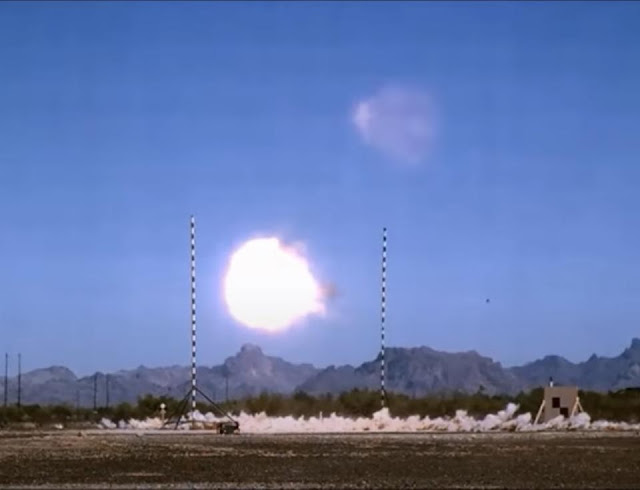
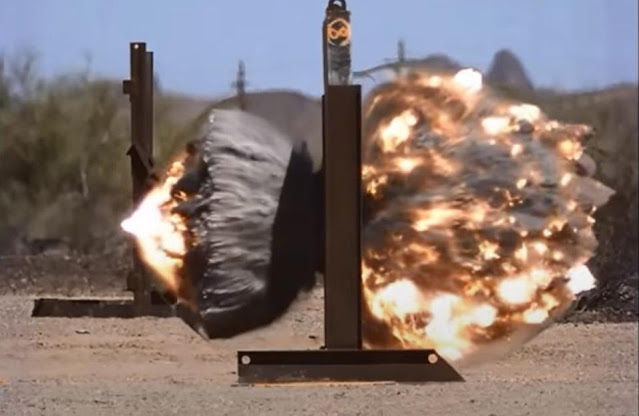


The tankers pushed each other hard, testing the AMP round in what evolved into a competitive shooting competition in the Yuma desert, both day and night.

Test Team Master Gunner Vehicle Crew Evaluator Master Sgt. Joel Ramirez, of the Fort Hood, Texas-based U.S. Army Operational Test Command said the purpose of the operational testing is to collect performance data and Soldier feedback to inform the Army’s procurement decision regarding the AMP round.

“We do this by having the tank crews employ the tactical service round in a manner and in an environment that closely mimics combat conditions,” said Ramirez.

He went on to explain how the 3rd ABCT tank crews shot over 8 complex modified tank gunnery combat scenarios during the four-day record test.

“Despite extreme desert heat, dust storms and rain squalls, the Crazy Horse crews really impressed me with their level of motivation and drive to test the AMP round,” said Mr. Kent Evans, the Maneuver Requirements Division Soldier and Capability representative from Fort Benning, Georgia.

The XM-1147 Advanced Multi-Purpose (AMP) round was designed to enhance a tank crew’s ability to perform missions with greater lethality and survivability, according to Mr. Jeff McNaboe, lead project engineer, Program Manager for Maneuver Ammunition Systems.

Developed by engineers from Picatinny Arsenal, New Jersey, the Advanced Multi-Purpose (AMP) round is a replacement for 4 legacy service rounds.

Via www.army.mil

Tuesday, October 5, 2021

The documents about the front hull special armor the basic M1A2 tank used

Damian Ratka have found very interesting data about the basic M1A2 hull frontal armor package.


The two interesting sources at DTIC archives, that might answer us what type of front hull special armor the basic M1A2 tank used. These sources are Ballisticians in War and Peace vol.3 and The U.S. Army Laboratories at Watertown, Massachusetts.


First document from Ballisticians in War and Peace vol.3 says to us that BRL (Ballistic Research Laboratory) developed special armor for M1A2 hull front providing 35% more KE and 25% more CE protection vs original M1A1 front hull armor.


The secend document is the U.S. Army Laboratories at Watertown, Massachusetts document, provides us information that Watertown with BRL developed in 1988-1991 timeframe a tandem ceramic armor that provided 33% increase in protection vs KE threats. Coincidence? I don't think so.


So we might safely assume, that while basic M1A2 used Heavy Armor Package with DU alloy in turret, hull used Tandem Ceramic Armor Package. 


Sources:

Ballisticians in War and Peace

THE U.S. ARMY LABORATORIES AT WATERTOWN, ASSACHUSETTS - CONTRIBUTIONS TO SCIENCE AND TECHNOLOGY: A HISTORY


P. S. Some data about Abrams armor:

ტანკების ჯავშანდაცვა - NATO vs СССР

დასავლეთის ტანკების ჯავშანდაცვა (Abrams M1, Leopard-2, Challenger 1/2 და Leclerc)

ოფიციალური დოკუმენტი M1 Abrams-ის კომპოზიტური ჯავშნის შესახებ

ტიტანის ჯავშანი - ანუ როგორ შევამციროთ Abrams-ის წონა


Tuesday, May 11, 2021

Latest iteration of M1 Abrams main battle tank wraps up testing at Cold Regions Test Center

By Mark Schauer


What has outstanding offensive and defensive capability and represents the aweing tip of the spear in a major land war?

It’s the M1A2 System Enhancement Package (SEP) version 3 (v3) main battle tank, which wrapped up extensive coldweather testing at U.S. Army Cold Regions Test Center (CRTC) this winter to ensure it functions as it should wherever in the world it could be called on to serve.

Since testing at the Department of Defense’s lone extreme cold natural environment testing facility began in January 2020, the SEPv3 was driven more than 2,000 miles in rugged conditions across three seasons of sub-Arctic weather, fired hundreds of rounds for accuracy in extreme cold, and underwent testing of its auxiliary power unit, as well as numerous other sub-systems.

The list of improvements to test in the SEPv3 is lengthy: improved fire control electronics mean the SEPv3’s gun can shoot faster and more accurately; the armor has been improved; it can even utilize hubcaps and road arms manufactured with a 3D printer. Onboard diagnostics are much more robust, and technical manuals can be accessed from removable screens.

Though the platform was extensively tested at Yuma Test Center prior to being put through its paces in Alaska, the sub-zero temperatures brought forth glitches that would have been unimaginable in the desert.

“While we were doing the main weapon firing, we ran into a system issue where we weren’t able to fire,” said Elissa Palm, test officer. “After some pretty extensive troubleshooting, we were able to work with the product manager to identify a fix. We were able to prevent non-mission capable tanks from being fielded and implemented the fix across the fleet, then validated here with additional testing.”

Conducting evaluations in the extreme cold of an interior Alaskan winter usually brings unexpected challenges even for the rugged professionals of CRTC, and this test was no different. One night, overflow ice from the nearby Delta River flooded the gun position, then quickly refroze rock-solid.

“We had one of the portable latrines with ice that was hip-high: you weren’t going to move it until it got melted,” said Greg Netardus, Chief of CRTC’s Test Operation’s Division. “All of the equipment was frozen in: wheeled vehicles carrying the ammunition would not have been able to maneuver down there. It was not safe to put people down here.”

CRTC’s vast expanse includes other ranges that could be utilized, but not ones that had important infrastructure that the testers needed.

Since testing began in January 2020, the SEPv3 was driven more than 2,000 miles in three seasons of sub-Arctic weather, fired hundreds of rounds, and underwent testing of its auxiliary power unit, as well as numerous other sub-systems. (Photos by Sebastian Saarloos)


“We don’t have multiple ready to fire ranges with targets at known distances for the tank, so our Allied Trades shop did a really nice job in a very short time building a new mobile target based on a Conex and getting it set up for us,” said Palm.

The target that CRTC’s Allied Trades shop had to recreate on the fly consisted of tall poles upon which a target is pulled into place with a hand crank. The fixed target is emplaced in the ground, which required approvals for work and brush clearance prior to construction.

“We used a 40-foot ISO container as a base, so there was no dirt work or anchoring required,” said Sam Porter, CRTC’s Allied Trades Lead. “An ISO container meant we could build it offsite in the shop, where we had cranes and a man lift. We took the design of the target that was in place and modified it.”

The mobile target was re-used in the summer, and provides a flexible new capability for future tests.

“With this, they should be able to set it up and utilize wherever they are able to fire that gun,” said Porter.

To take advantage of the coldest temperatures possible, weapons firings were oftentimes conducted in the small hours of the morning. Possibly the most difficult testing challenge, however, occurred earlier in the calendar year: when the COVID crisis hit in March 2020, eight members of the testing team who had come to CRTC from Yuma were especially impacted by sudden restrictions in travel and new temporary duty (TDY) authorizations.

“A lot of times on these long-term tests, we like to trade people in and out so they can get back to their families,” said Palm. “This time it was really hard for us to get TDY approvals, so the crew was great in that most of them volunteered to stay until the end of the effort.”

The M1 and its variants have been tested at U.S. Army Yuma Proving Ground and its constituent test centers for more than 40 years, and likely will continue to be for as long as the system remains in the ground combat arsenal. This testing has played a vital role in keeping the M1 the most capable tank in the world.

Via "The Outpost" newspaper

Saturday, March 20, 2021

A M1A2 Abrams MBT damaged by an IED


A M1A2 Abrams MBT of the US Army, damaged by an IED. The IED used metal balls, and it caused little damage to the MBT. Mosul, Iraq, January of 2008.


Via Lost Armour

Thursday, February 25, 2021

US Army Bradley IFV side by side with the Kuwait Army's BMP-3 IFV and Abrams MBTs

30 years ago a US-led coalition helped liberate Kuwait during the Gulf War. This week an Al Tahreer exercise was held in honor of the anniversary. Below, US and Kuwaiti forces conduct a simulated breach of an enemy position.


The BMP-3 IFVs and M1A2 Abrams MBTs of  from 6th Mechanized Brigade of Kuwait Land Forces and the U.S. Army Bradley Fighting Vehicle from 1st Battalion, 35th Armored Regiment, 2nd Brigade, 1st Armored Division, crosses through a simulated enemy barricade during the live-fire exercise portion of Al Tahreer, Feb. 18, 2021, at Udairi Range Complex in Kuwait. 


Photo by Staff Sgt. Daryl Bradford

Friday, January 15, 2021

Fast facts about Abrams M1A2 SEPs MBT and Trophy APS


US Army began fielding the Abrams M1A2 SEPv3 in 4QFY20. The Abrams M1A2 SEPv3 is an upgrade to the Abrams M1A2 SEPv2. The upgrades include:


  • Power generation and distribution to support the power demands of future technologies
  • Compatibility with joint battle command network
  • Survivability enhancements including Next Evolution Armor and reduction in vulnerability to IEDs including those controlled remotely
  • Improved lethality by providing the ability for the fire control system to digitally communicate with the new large caliber ammunition through use of an ammunition datalink
  • Energy efficiency and sustainment due to the incorporation of an under armor auxiliary power unit (UAAPU)
  • Improved silent watch capability


The Army plans to begin fielding the Abrams M1A2 SEPv4 in 1QFY25. The Abrams M1A2 SEPv4 is an upgrade to the Abrams M1A2 SEPv3. The upgrades include:

  • An improved Gunner’s Primary Sight (GPS) with 3rd Generation Forward Looking Infrared (3GEN FLIR), an Improved Laser Range Finder (LRF), and Color Camera
  • An improved Commander’s primary sight with 3GEN FLIR, an improved LRF, laser pointer, and color camera
  • Improved lethality by providing the ability for the fire control system to digitally communicate with the new Advanced Multi-Purpose (AMP) Round
  • Improved firing accuracy through the installation of a Meteorological Sensor
  • Improved onboard diagnostics
  • The Army began fielding the Abrams M1A2 SEPv3 domestically and OCONUS in FY20.
  • In 1QFY20, the Army completed live fire testing of the Abrams M1A2 SEPv3 tank. The last test series in the program evaluated the ability of kinetic threats to perforate the internal ammunition compartment and the subsequent reaction of the stowed ammunition on the Abrams M1A2 SEPv3 tank mission and the crew.

Trophy Active Protection System
  • In 4QFY19, the Army completed the testing of the Abrams SEPv2 with Trophy APS, which included maneuver, gunnery, and live fire test events. In June 2020, DOT&E published a classified test report summarizing the Abrams SEPv2 with Trophy APS performance.
  • The Army is currently planning the live fire test program for Abrams SEPv3 with Trophy APS. The test program is scheduled for 2QFY21 through 4QFY21.
  • The Trophy APS adds approximately 5,000 pounds  (2268 kg) to the Abrams tanks.

Assessment
Abrams M1A2 System Enhancement Packages
  • The Armored test unit equipped with the Abrams M1A2 SEPv3 accomplished its assigned task in 19 of 20 missions during operational testing. The UAAPU improves the unit’s ability to accomplish continuous operations, and the upgrades have not degraded the vehicle’s combat capability. Fuel usage when operating the Abrams M1A2 SEPv3 with the UAAPU was 78 percent less than the amount used when running the main engine at idle for the same amount of time.
  • Upgrades mitigate the Army’s identified capability gaps for the Abrams M1A2 SEPv2.
  • The Abrams M1A2 SEPv3 demonstrated 441 mean miles between combat mission failures (MMBCMF), exceeding its requirement of 320 MMBCMF during operational testing.
  • The Abrams M1A2 SEPv3 upgrades introduce suitability concerns. Weight growth limits the tank’s tactical transportability. The M1A2 SEPv3 is not transportable by current recovery vehicles, tactical bridges, or heavy equipment transporters. Crews had difficulty operating government-furnished equipment. The CROWS-LP thermal sight washed out during operations and had difficulty receiving software reloads. The Army could not reproduce the thermal wash out during testing.
  • The UAAPU reduces the acoustic detectability range of the Abrams M1A2 SEPv3 by 62 percent, when compared to the Abrams M1A2 SEPv2.
  • DOT&E continues to analyze the live fire test data to evaluate the Abrams M1A2 SEPv3 survivability and force protection against operationally expected threats. DOT&E will publish the M1A2 SEPv3 survivability and force protection evaluation details in a classified report in 1QFY21

    Wednesday, December 23, 2020

    China army uses mock-up of M1 Abrams tank for combat training

    A mock-up of a US-made M1 Abrams main battle tank, based on wheeled platform, was spotted in  China.

    The photograph was shared online by 彩云香江 Chinese bloger

    The specific role of the realistic mock-up has not yet been clarified, but propabely it will be used in OPFOR missions. Similar mock-ups of military vehicles and defense systems used in many parts of the world for training purposes.

    Previously in China has spotted a mock-up of a Russian-made T-90 main battle tank. So, PLA preparing for all possible scenario on the battlefield.


    Monday, December 14, 2020

    Thursday, November 5, 2020

    US Army woking on Abrams MBT sucessor project

    US Army Abrams MBT's sucessor will be optional manned tank (OMT):

    In early October, six Soldiers from Ft. Benning reviewed and provided critical design feedback on four future Optionally Manned Tank (OMT) concepts to refine, to downselect, and to improve the concepts in FY21. This was the third Soldier Touch Point under GVSC's Virtual Prototyping program.


    Today’s US Soldiers are helping to inform early development and engineering decisions on the Army’s next tank through Virtual Prototyping.

    Six soldiers conducting a virtual experiment to provide input for the Optionally Manned Tank (OMT), a project in the early stages of development by the Army. 

    Ultimately, the OMT program seeks to explore options for a possible future main battle tank through virtual prototyping. Virtual prototyping is a process the Army is using to create and assess multiple OMT vehicle concepts. The concepts are informed by Soldier Touch Points and enhanced modeling and simulation (M&S). The input from Soldiers helps to drive requirements and science and technology investment. 


    With the completion of the Virtual Experiment, team will now review the collected data to refine and update the OMT virtual prototypes based on the Soldiers’ feedback.

    Additional experiments are scheduled to occur in FY21/22. Upcoming experiments will provide further insights into the development of the OMT based upon refined learning objectives and lessons learned from previous experiments. The experiments will also be conducted against a simulated near-peer adversary in an operational environment to better understand and develop future vehicle requirements.

    The Army plans to make a decision in 2023 on possible options to develop a new tank.