The latest iteration of Merkava is called Mark 4 Model 400, which has a newer C2 (Command and Control) system and enhanced TROPHY (note the the added optical sensor over the radar).


The latest iteration of Merkava is called Mark 4 Model 400, which has a newer C2 (Command and Control) system and enhanced TROPHY (note the the added optical sensor over the radar).
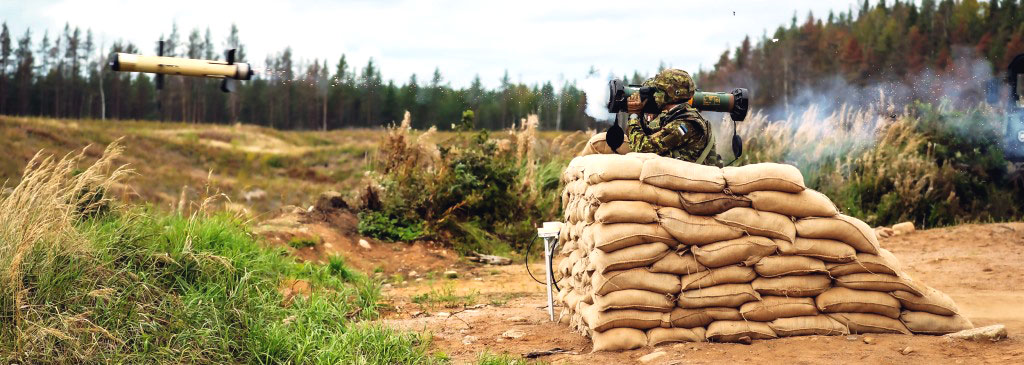
EuroSpike’s (a European Joint Venture between Rafael Advanced Defense Systems, Diehl Defence and Rheinmettal Defence) SPIKE SR it is an advanced, shoulder-launched, guided missile, designed for modern infantry warfare. SPIKE SR’s ease-of-use allows the lower echelon infantry to qualify rapidly and to sustain a high level of operation with almost no continuous training.
The SPIKE SR utlilises 3rd generation dual electro-optical (day/night) seeker technology in a versatile lightweight multi-purpose missile that can be used by the infantry or by Special Forces.
The state of the art seeker technology (day/night), including uncooled IIR, high resolution CCD as well as an optimized tracker is tailored to the needs of infantry forces in a variety of operational and environmental scenarios.
A particular advantage of the SPIKE SR include a light weight of only 10kg, operational simplicity, and an enhanced range of 2000 meters with the short time interval from power on to operational readiness, perfect for targets that are only exposed briefly.
During the demo the EDF evaluated the system’s operation and fired two SPIKE SR missiles successfully, with precise target hits.
In addition to the firing of live rounds, the EDF activated the different training means of the weapon system, including outdoor and indoor trainers. The EDF also evaluated the high level of portability of the SPIKE SR, and the highly-effective tandem HEAT (High Explosive Anti-Tank) warheads, which allow advanced modern armor penetration, and the critical stand-off range of 2000m.

The demo was attended by several European delegations, members of the SPIKE User Club, and was preceded by brief instruction of the EDF team on the operation of the weapon.
Packed in a 98 cm long canister, SPIKE SR is highly portable, allowing infantry to easily and rapidly deploy with the weapon in any ground infantry maneuver.
In September 2019, the Estonian MoD signed a 40M Euro Framework agreement with Eurospike for the supply of SPIKE LR ATGM’s, launchers and associated maintenance and training. The contract included ICLU (Integrated Control Launch Units) launchers and live SPIKE rounds.
Estonia is one of 35user nations of the SPIKE missile, and one of 19usersin the EU and NATO. More than 33,000 SPIKE missiles have been supplied to-date around the world, with over 5,500 SPIKE missiles fired both in training and in combat.


Armenian forces released the video, which shows the how they defeat the enemy armour.


In the northernmost IDF outpost in the security zone in southern Lebanon sat a “surge company”. A secret armored company, which every soldier who served in the outpost knew that its tanks should not be touched. Of course they did not know the reason – these are tanks with a “purple thunder” (רעם סגול) system. Because of anti-tank missiles that were still in development.
Twenty years after the company was disbanded, the full story of the experiment conducted in real conditions, against an enemy, in southern Lebanon, was allowed to be published. Even today the fighters who served in the company are not sure if it was a successful experiment or a failure.
Hermon David was a young and poisoned officer in a surge company 22 years ago. “We were a very secret company,” he said for the first time about the experiences in the experiment. “We were regularly stationed at the basin outpost, the hottest, most complicated and most threatened place – at the end of the security strip. All the time we had to cover the tanks and equipment and hide our mission.”
At that time, many armored companies operated and fought in the security zone, but unlike the other companies, surge fighters served continuously in southern Lebanon. “We were stationed in the hottest sector in Lebanon, the basin post, which abducted many fighter fighters in those years. Beyond trying to test the system we also had a lot of active successes. Our force was very skilled, with combat experience on the ground, constantly doing the same thing – Lebanon.”
“Our goal was to be in the most dangerous and problematic place all the time, to check the functioning of the system when Hezbollah fires a missile at us,” described David, who served as the company’s deputy commander. “I mean, if the system works it’s fine, but if the system doesn’t work it’s not good.”
Ari Brock, who served as a tank commander, added: “We made a lot of trips in daylight and in front of controlled areas, especially in combat incidents. The intention was to fire a missile at us, who just fired. We were pretty prepared for that, even in coverings. You are less afraid of being exposed in daylight See what happens when a missile is fired at you. “
“On our first two lines in Lebanon they let us play. We would do new things, travel to distant territories. One day we stood in daylight on a spur and waited for a missile. A missile arrived that exploded near the tank caterpillar, but nothing happened to us and the system was not activated,” Brock said. Immediately afterwards he explains that the mission was not to just stand still, but was an operational need “my team also took down two terrorists”.

Despite the shroud of secrecy and full adherence to field security practices, the secret story that ran in southern Lebanon about the special tank company from the Reihan outpost rolled to the ears of the young armored personnel of the time. The stories were about a company with a secret system that eliminates dozens of terrorists and initiates daring operations.
“We did a unique activity from the very activity that was carried out,” said the company’s last commander, Omri Miron. “We changed the concept of the activity a bit – from ambushes of infantry and tanks to skipping ambushes of two pairs of tanks – at unconventional hours and not throughout the night. I felt safe thanks to the people who were with me, and thanks to the professionalism and seriousness we demonstrated in the preparations we made for everything. ”
But throughout the service in southern Lebanon the fighters knew they were putting themselves in danger. “There were situations we knew about missile squads that were about to fire so we stood really exposed. We relied on the system. Lee, as a tank commander, had the knowledge that if we were fired at a missile then ‘purple thunder’ would disrupt it,” Brock said.
“My desire was to immigrate to Lebanon and be in a special place – and I got what I wanted,” added Roi Ofer, who was also a tank commander in the company. “I realized that I was part of an experiment and that the military was testing the effectiveness of the system, but I do not think we felt in the experiment. The goal as we understood it is that we are here to be shot at.”
Ofer expanded: “Feelings change all the time. On the one hand you are on the front of the front, and you are on a tank that does not look normal and you are there to hijack missiles, to test the system. On the other hand, no one wants to be in this situation. Maybe we were kind Of ‘Trial Rabbit’, but that was the only way to test it. “
Colonel Reli Margalit is now recognized as the one who postponed the release to head the Home Front Command epidemiological investigation system. In those years he commanded a surge company. “It was a very special company, built with the idea of an operational experiment in a defensive concept that allows for something more offensive and at no point was there a sense of a guinea pig.”
“We thought it was right and appropriate, and we were also part of the development. We had a lot of other experiments that we were partners in and we saw that they worked,” he added. “Our feeling was that we were saving the country.”
“I do not think we were an experimental rabbit,” Brock also supported. “The truth is that we were never fired upon by a direct-launch missile, so I can not say that the system was successfully tested. We relied on the system.”
After the withdrawal from southern Lebanon in 2000, the military experiment in “purple thunder” was stopped and the special company was disbanded. Throughout the years it operated in the security zone, the company’s tanks were subjected to many mortar stresses and almost all types of fire, except for anti-tank missiles, which the special system was built to protect against.
“Factually, at that time no missiles were fired at us as we expected it to happen,” said Col. Margalit.
– Sucks?
“A bit. There is a very big paradox here. I certainly miss that period, for the fighters there it was a period of self-fulfillment. We were in an experience that is very, very significant and fascinating in Lebanon. We developed all kinds of different techniques and all kinds of norms that were not customary in the security zone. “Somewhat bolder actions, but it was more because of our professionalism.”
The disappointment that the system was not tested in real time is felt by all the fighters we spoke to. “Everyone in our company wanted to see if the system worked or not,” Ofer said. “Everyone in the battle wants to come across, they will shoot at you and put them in. On the other hand, you terribly want not to, and it’s scary murder. These are feelings that come together. There were very scary moments. On the tank. “
More than twenty years after the company’s activity ended, the fighters are trying to explain how they agreed to put themselves in the situation. “You could call it a soldier’s youthful stupidity,” Brock said. “Today it would not have happened, but as a 20-year-old you are sure it will work.”
“It may not be true to say, but I have a kind of regret that the system was not tested under fire,” David said. “It’s a paradox because you seem to have to save your life and your ambition is that they will not fire missiles at you, and if they do shoot they will not hit. But as a fighter with a mission and a goal – I felt a kind of miss.”
After the withdrawal from Lebanon, the then commander of the Northern Command, Gabi Ashkenazi, awarded the company a troop following the activities of its fighters in the months before and during the withdrawal.
The defense establishment responded: The ‘Purple Thunder’ system is an active defense system developed by Mapat, Elta and IMI. After proving the system’s performance in a series of live experiments, the land arm decided to set up the company for an operational examination of the system. After completing the operational examination, and with the departure of the IDF from Lebanon, the ground arm decided to dismantle the systems and transfer them to storage.

The “Purple Thunder” system formed the basis for the capabilities and systems that exist today and placed Israel at the forefront of global technology in dealing with the threat of anti-tank missiles. It should be emphasized that from the outset the company’s SDK was in addition to the existing operational SDK of the IDF Armored Brigades, so that its closure did not affect the SDK of the operational forces required to meet IDF missions.
“As for the claim that the systems experiment led to risk-taking, it will be clarified that the company operated under the same procedures and orders of all the armored companies that operated in the security strip and therefore there was no change in the way it operated in relation to other armored companies.”

Elta and Elbit (the current owners of IMI) declined to comment on the experiment.
Via News1

IronVision™ is the near eye display system for ground combat vehicles, providing situational awareness for crews inside armored vehicles. This low-latency technology allows soldiers to see through the armor of vehicles smoothly, and fight with closed hatches. IronVision provides 360-degree situational awareness that increases survivability and effectiveness of the vehicle. IronVision™ also allows integration with fire control system of the vehicle, which significantly increases vehicle lethality.
The system previously was demonstrated on the Elbit Systems innovative Armored Fighting Vehicle (AFV), as part of the CARMEL Future Combat Vehicle project of the Israeli Ministry of Defense.


Today the Israel Missile Defense Organization in the Ministry of Defense, delivered the first of two Iron Dome Defense System batteries to the U.S. Army. A symbolic event was held at the Iron Dome production line of defense contractor, Rafael Advanced Systems.
Defense Minister Gantz: “The completion of this agreement serves as further proof that the defense alliance [between the U.S. and Israel], is based on common values and interests, which are stronger than ever."
Today the Israel Missile Defense Organization in the Ministry of Defense, delivered the first of two Iron Dome Defense System batteries to the U.S. Army. A symbolic event was held at the Iron Dome production line of defense contractor, Rafael Advanced Systems 1/2 pic.twitter.com/kkfkfMAXTs
— Ministry of Defense (@Israel_MOD) September 30, 2020
US Army receives 1st of 2 Iron Dome batteries, unlikely to buy more. After Israel refused to hand over underlying source code for the powerful air defense system, American military put plans to acquire further units on hold.
The US and Israel signed an agreement for the purchase of the two batteries — each of which include a launcher and missiles made by Rafael Advanced Systems Ltd., a radar array made by the ELTA defense contractor, and a command-and-control center developed by the mPrest firm — last August, with initial plans to buy both two more units and to consider deeper integration of the Israeli air defense system.
In March, however, the US Army indicated it was scrapping — or at least freezing — its purchase of the two additional batteries and the further incorporation of the Iron Dome into its aerial defenses.
Though the deal appears to have stalled, Rafael continues to meet with US officials about the matter, a spokesman for the company said Wednesday, stressing that no final decision had been made on the deal.


Photos of the Georgian Army's Air Defence System Spyder-SR at the Georgia Independens Day, 26 May of 2017 (Link 26 მაისის ღონისძიებაზე გამოტანილი ებრაული ჰსთ კომპლექსი Spyder-SR და ზცრს LAR-160)We have signed an important agreement with @RAFAELdefense of #Israel, according to which our air defence systems will be fully modernized. This agreement demonstrates our strong effort to develop Georgia's air defence capabilities for stronger resilience and deterrence. pic.twitter.com/xQpYpsqZMB— Irakli Garibashvili (@GharibashviliGe) September 11, 2020


