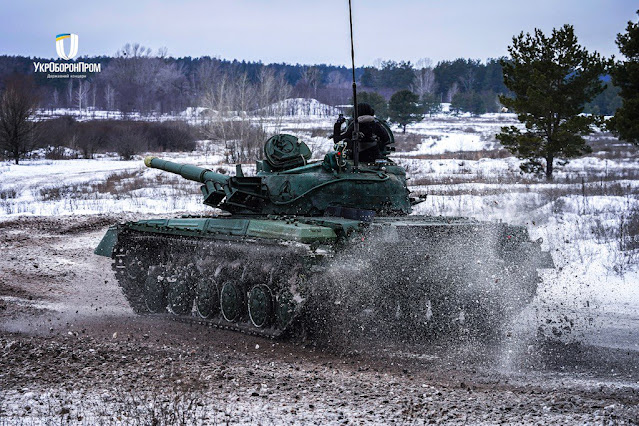
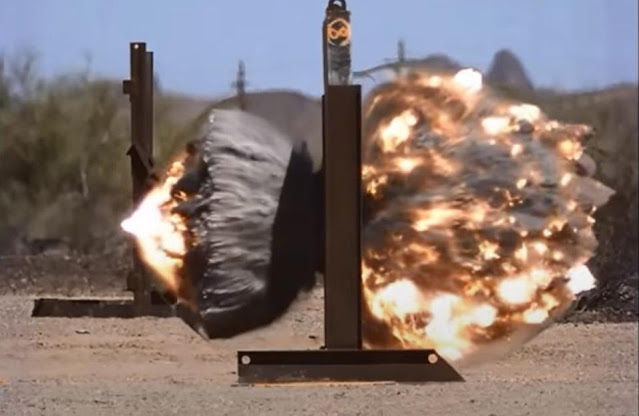
The Ukrainian KhBTZ started trials of the T-64BV Obr.2022 tank. The vehicle is equipped with new fuel system, protected fuel tanks, new Laska K2 12,7 mm AA Machine Gun, new surveillance and sighting systems (most possible the 1G46 instead of the 1G42), new lights and communication and navigations systems.
As i walk through the valley of the shadow of death, I have no fear because I am the baddest motherfucker in whole valley.
Tuesday, February 8, 2022
Saturday, February 5, 2022
Kornet-D ATGM vs Merkava Mk4 MBT
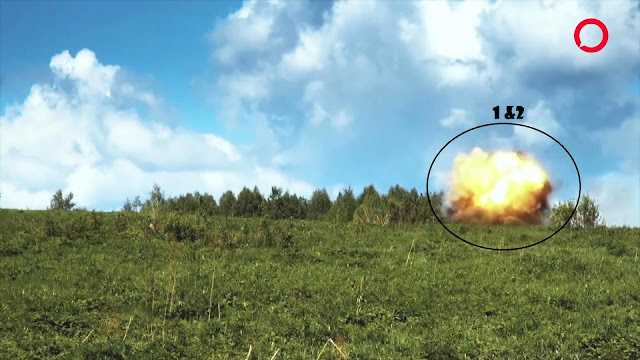
The TV channel RT Arabic release video about self propelled Kornet ATGM. At the end they showing Merkava Mk4 MBT mockup as target.
On the video from Kornet-D Self Propelled ATGM was launched salwo of two missiles with very small time difference to break through the APS.
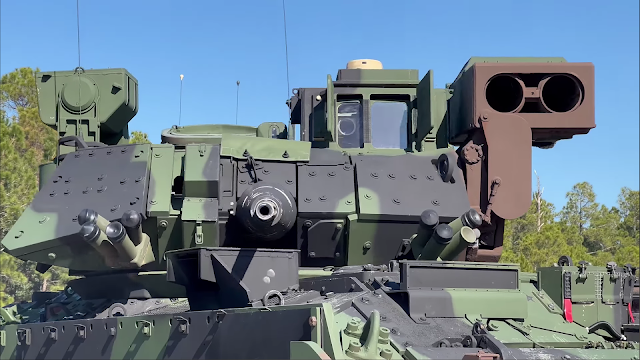
US Army field for the first time the modernized M2A4 Bradley IFVs
Spartan Soldiers assigned to 2nd Armored Brigade Combat Team, 3rd Infantry Division are the first in the U.S Army to field the newly modernized M2A4 Bradley Fighting Vehicles as part of the Marne division's glidepath to become the most modernized division in the U.S. Army by summer 2023.(U.S. Army Video by Sgt. Trenton Lowery).
Friday, February 4, 2022
Strong start to Ex WINTER CAMP over the last few days with eFP Estonia Battlegroup.
Integrating armour, infantry and engineering capabilities whilst sharpening our cold weather skills.
Strong start to Ex WINTER CAMP over the last few days with eFP Estonia Battlegroup.
— Col Dai Bevan (@ComdUKeFP) February 3, 2022
Integrating armour, infantry and engineering capabilities whilst sharpening our cold weather skills.
🇬🇧🇫🇷🇪🇪 pic.twitter.com/7KFNvDm3Wf
The T-64BV MBTs of the Ukrainian Armed Forces reserves in winter camouflage
Exercise of the tank reserves of the Armed Forces of Ukraine were held in the Donetsk region. During training, the crews trained to moving out of the concentration area to the firing line, maneuvers as part of a company against a possible enemy, and performing tasks in conditions of a sudden change of the situation.
Source Joint Forces Operation
Wednesday, January 26, 2022
OSHKOSH DEFENSE UNVEILS FIRST-EVER SILENT DRIVE HYBRID ELECTRIC JLTV
Adds silent drive, extended silent watch, increased fuel economy and exportable power without sacrificing performance or protection
OSHKOSH, Wis. (January 25, 2022) — Oshkosh Defense, a wholly-owned subsidiary of Oshkosh Corporation (NYSE: OSK), unveiled the first-ever silent drive hybrid-electric Joint Light Tactical Vehicle (JLTV), the eJLTV.
The eJLTV offers the U.S. Army and U.S. Marine Corps the same level of performance and protection as the base JLTV with the addition of silent drive, extended silent watch, enhanced fuel economy, and increased exportable power that enables it to be used in combat and reconnaissance scenarios.
The eJLTV charges the battery while in use, fully recharging the lithium-ion battery within 30 minutes. This eliminates the need for a charging infrastructure, which remains one of the most significant challenges to the widespread electrification of the tactical wheeled vehicle fleet.
“For many years, we’ve been developing, testing and evolving hybrid-electric variants of our heavy and medium-duty tactical wheeled vehicles,” said John Bryant, Executive Vice President for Oshkosh Corporation and President of Oshkosh Defense. “Now, with the eJLTV, we’re offering our military customers an affordable way to electrify their light tactical wheeled vehicle fleet without compromising the off-road performance or superior protection necessary in combat operations.”
This year, the U.S. Army plans to recompete the JLTV program and issue a follow-on production contract in September 2022. The follow-on contract, valued at $6.5 Billion, includes an additional 15,468 vehicles and five order years followed by five options years, extending production through FY32.
“While the U.S. Army has not requested a hybrid-electric JLTV as part of the JLTV recompete, the eJLTV proves that Oshkosh Defense has the team and technical capabilities to produce this highly capable vehicle today,” Bryant concluded.
About the eJLTV:
- Maintains the performance and protection of the proven Oshkosh Defense JLTV
- Improves fuel economy by more than 20%
- Provides battery capacity of 30kWh with opportunity for growth
- Eliminates the need for a towed generator by providing export power capacity of up to 115kW
Oshkosh Defense and its parent company, Oshkosh Corporation, have a rich history in electrification and are pushing the boundaries of innovation for customers. One example is the Oshkosh Defense diesel electric Light Combat Tactical Vehicle (LCTV), from which the Oshkosh JLTV is derived. The LCTV was the world’s first military vehicle to finish the grueling SCORE Baja 1000 off-road race. In addition, Oshkosh Defense was awarded the contract to develop and manufacture the U.S. Postal Service’s Next Generation Delivery Vehicle (NGDV), which calls for the delivery of between 50,000 and 165,000 vehicles over a period of 10 years and will consist of both zero-emission battery electric vehicles (BEV) and fuel-efficient low-emission internal combustion engine vehicles (ICE), upgrading the USPS fleet to be increasingly sustainable.
Source Oshkosh Defense
Saturday, January 22, 2022
DARPA’s Robotic Autonomy in Complex Environments with Resiliency (RACER)
RACER Revs Up for Checkered Flag Goal of High-Speed, Off-Road Autonomy
Vehicle mobility development experiments planned as Phase 1 kicks into gear with fleet delivery and data collections
DARPA’s Robotic Autonomy in Complex Environments with Resiliency (RACER) program is picking up speed after three teams were selected to go to the starting line last October. The program is focused on advancing off-road autonomy of combat vehicles and seeks to demonstrate the ability of these platforms to travel at speeds that maintain pace with manned combat vehicles in complex terrain typical of that seen in real situations. Awards for Phase 1 were given to Carnegie Mellon University, NASA-Jet Propulsion Laboratory, and University of Washington.
The DARPA RACER program’s goal is to develop and demonstrate autonomy technologies that enable unmanned ground vehicles (UGVs) to maneuver in unstructured off-road terrain at the limit of the vehicle’s mechanical systems and at, or beyond, human-driven speeds and efficiencies. “RACER is intended to disruptively advance the integration and fielding of autonomy for robotic combat vehicles into the Army, Marine Corps, and Special Forces communities,” said Stuart Young, RACER program manager in DARPA’s Tactical Technology Office.
In November, the selected teams received the first of the DARPA-provided RACER Fleet Vehicles (RFVs) – a high performance all-terrain vehicle outfitted with world-class sensing and computational abilities – that they are using to develop platform-based autonomy for testing at upcoming DARPA-hosted field experiments.
RFV robots include 360o range and image sensing such as multiple LIDARs, stereo camera pairs, color and infrared imaging cameras, RADAR, event sensors, and inertial measurement sensing. Computation tools have multiple best-of-class graphical processing units (GPUs) in an environmentally protected, shock/vibration proof, and thermally managed Electronics Box (E-Box) that’s specifically engineered for the demands of the RACER high speed, off-road terrain expected in DARPA’s tests.
The sensor and E-box combination currently collects four terabytes of sensor data per hour to support artificial intelligence, machine learning-based autonomy algorithms and stack approaches required of fast-paced combat maneuvers in complex terrain. Modifications for roll protection, sensor/E-box integration, autonomous control, and increased 7kW of power are included in each RFV. The RFVs were integrated by Carnegie Robotics LLC (CRL) and are housed on a Polaris RZR S4 1000 Turbo base drive-by-wire platform.
Four RFVs have been completed, with three already delivered to RACER Phase 1 performers in November 2021. Four more are expected to be built prior to DARPA’s first RACER-hosted field experiment, scheduled for March of 2022 at the National Training Center in Ft. Irwin, California.
DARPA-hosted field experiments will provide the teams with a place to demonstrate the full capability of their autonomy stacks in complex environments. At Ft. Irwin, teams will demonstrate their ability to navigate courses with a variety of terrain and distances up to five kilometers.
To further support software development, DARPA has also collected over 100 terabytes of RFV-based sensor data from more than 500 kilometers of terrain in the Mid-Atlantic and West Coast. Shared with teams and managed within a RACER development tool for efficiency and security, this data will assist with learning approaches. Conceptual government baseline stacks and autonomy architectures will also be provided. They leverage recent products of Combat Capabilities Development Command-Army Research Laboratory initiatives in collaborative robotics, learning, and intelligent systems activities in partnership with basic research university and industry consortia.
The RACER program also has awarded two contracts to develop simulation environments and capabilities to enable development of off-road autonomy algorithms. “The RACER-SIM portion of the program looks to expand current simulation capabilities and physics-based models to support the testing of off-road autonomy in virtual environments,” said Young. “These simulation environments will allow teams to test and validate portions of their autonomy stacks without having to spend large amounts of time and money with field testing.”
Source DARPA
Wednesday, January 19, 2022
EGS (Experimentalwanne Gesamtschutz) technology demonstrator for the NGP (Neue Gepanzerte Plattform) project
Tuesday, January 11, 2022
Rate of fire is the “key” to overmatching adversaries
Brig. Gen. John Rafferty, director of Long Range Precision Fires (LRPF) Cross Functional Team calls rate of fire the “key” to overmatching adversaries.
During the week leading up to Project Convergence 21 (PC 21), a team of dedicated individuals made up of Yuma Proving Ground (YPG) and U.S. Army Combat Capabilities Development Command (DEVCOM) Armaments Center employees proved the Extended Range Cannon Artillery (ERCA) ammunition handling system (AHS), better known as the autoloader, is the key to unlocking a high rate of fire.
The demonstrations during PC 21, the Army’s campaign of learning, experimentation and demonstration held at YPG, ended the science and technology (ST) phase for the autoloader.
Concept and design
Josiah Fay, Armaments Center ERCA project officer for ST, has been working on the project nearly six years, starting during the initial concept phase.
“I thought it was great. We had not had the opportunity to develop an artillery system in a very long time,” said Fay.
While the autoloader was specifically under test during PC 21, Armaments Center autoloader lead Jim Lee explains, the work of each component in sync is what allows the AHS to do its job.
“ERCA is a very comprehensive armament system. Rate-of-fire is not just the autoloader, it’s the gun, it’s the projectile, it’s the cab, it’s the pointing, it’s the fire control, and part of it is the autoloader. So, our group is in charge of handling the projectile and the propellant. Loading it into the gun very quickly. Loading the projectile, loading the propellant and then let the gun fire, then we repeat. That’s how we get the rate of fire. We try to do as many things as possible in parallel.”
Earlier this year, the team tested the first fully integrated AHS. Since that test in March of 2021, the team quickly implemented lessons learned, Soldier informed feedback, and design for suitability with the development of a second ammunition handling system that was demonstrated during Project Convergence. The AHS sits inside a self-propelled howitzer with a PIM chassis.
“It allows us to place that mechanized handling, that automation, inside to be able to get after the rate of fire. Reducing the burden on the Soldiers, allowing them to be able to do other things by means of automation. We still maintain a full crew with this, but we give them the option as well,” explained Richard Granitzki, Armaments Center LRPF ST advisor to Rafferty.
For testing purposes, the test crew executed the firing mission remotely for test range reasons, however, the manner in which the firing mission was executed showcased how a firing mission can be fully automated. “We are also showing what automated lethality would look like by conducting a multi-round burst coming from the autoloader system,” adds Granitzki.
The AHS is also versatile in the type of projectiles it can handle.
ERCA Autoloader controls lead Davie Gatter explains, “We first proved a five round burst with a single type projectile and super charges previously, whereas now we can handle MACS charges, supercharges, XM 660 stub charges, as well as the entire ERCA suite of projectiles, and fuzing those projectiles.”
The team
The final ST demonstration was the culmination of years’ worth of work. Many iterations and models led to what is now a working weapon system that was once dubbed the “renaissance of artillery.”
YPG’s test officers and gunners, many of whom formerly served in uniform, are one of the first to get their hands on the weapon system. Their feedback has helped with the design. One example, shares Granitzki, is the ammunition handling.
“Earlier iterations on how we did the resupply were much more crude. So being able to get that feedback has been able to help there. Including moving the charges inside the cab. It’s been invaluable.”
“We have a different perspective, because we have to use the system more than they do and they sometimes get lost in the programing and the hardware. We bring the user interface to it that I think helps them make it more usable for the Soldier down the road,” notes YPG Test Officer Casey Scharenbroich.
It’s no doubt the YPG team and the Armaments Center team have built a bond over this armament of the future.
“The commitment from YPG has been humbling. There is truly that comradery,” remarks Fay. “There is a belief here in the weapon system. They have seen us evolve this and there has been a trust built and that is really important.”
Future of ERCA Autoloader
“Our approach to the ERCA System has always been to start by increasing the range and lethality and then get to improving the rate of fire,” explained Rafferty.
In 2023 the first battalion set of ERCA with range and lethality will be rolled out. The rate of fire will eventually be integrated into the system.
Rafferty remarks, “The autoloader is one incredible option to put in the hands of our Soldiers.”
Ultimately, it is up to senior Army leaders to make the decision if the autoloader is the best option.
The demonstration and data collected provides leaders, “with the facts on the ground data that they can use to make an informed decision,” remarked Fay.
Via army.mil
Monday, December 6, 2021
Ivy Division Crazy Horse crews test Army’s newest 120mm Abrams Main Battle Tank round
Yuma Test Center, Arizona. — Deep in the desert here, two Ivy Division tank crews of the 3rd Armored Brigade Combat Team recently tested the Army’s newest 120mm tactical service round.
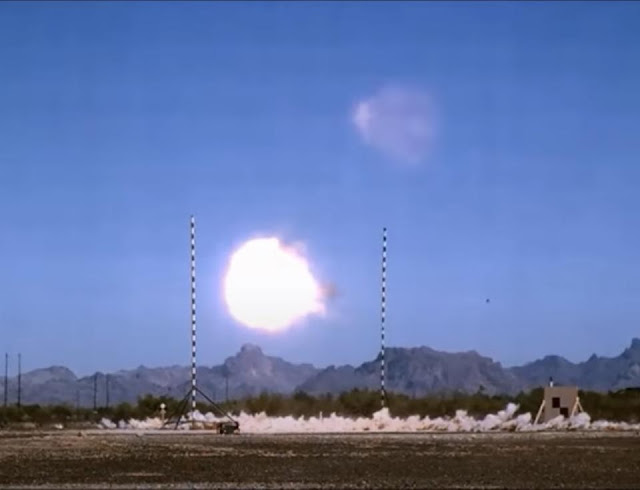
Under 112 degree-plus heat, they simulated combat missions with full ready rack combat loads of the XM-1147 Advanced Multi-Purpose (AMP) round for their M1A2 Abrams Main Battle Tanks against a host of actual and simulated threat targets.
Tank Crew 1 commanded by 2nd Lt. Jake Hall, with Gunner Sgt. Spencer Vanderbilt, Loader Pvt. Dalton Diserio, and Driver Pvt. Justin Jones, not only knows what it feels like to roll out in a fully combat loaded tank on an operationally-realistic simulated mission, but they have witnessed the firepower the AMP round brings to the fight.
“This round is not something to be taken lightly,” said Vanderbuilt, of Charlie Company “Crazy Horse,” 1st Battalion “Fighting Eagles” of the 8th Infantry Regiment.
“Being able to see and then destroy anti-tank guided missile targets beyond 2,000 meters and then transition immediately to breaching walls or obstacles is an incredibly powerful feeling!”
“We now know what it feels like to roll out in a fully combat loaded tank on operationally realistic combat missions and recognize how important the AMP round will be to U.S. Army ABCT fighting forces in the fights yet to be fought,” added Hall.
Tank Crew 2, commanded by Staff Sgt. Nicholas Smearman, with Gunner Sgt. Juan Segura, Loader Spc. Blake Phillips, and Driver Pvt. Adam Allwine, also unleashed AMP fury on the same host of targets in the Yuma desert.
Phillips, said he was amazed by the AMP round’s performance and awesome power.
“The Abrams Tank’s lethality has been re-vAMP’ed!” he said.
Capabilities of the AMP round included the new airburst mode and breaching double reinforced concrete walls.
After shooting over 90 AMP rounds at anti-tank guided missile teams, massed infantry, infantry fighting vehicles and bunker targets, the Crazy Horse armored crews unanimously agreed training conducted during the test was the best in their careers.
The tankers pushed each other hard, testing the AMP round in what evolved into a competitive shooting competition in the Yuma desert, both day and night.
Test Team Master Gunner Vehicle Crew Evaluator Master Sgt. Joel Ramirez, of the Fort Hood, Texas-based U.S. Army Operational Test Command said the purpose of the operational testing is to collect performance data and Soldier feedback to inform the Army’s procurement decision regarding the AMP round.
“We do this by having the tank crews employ the tactical service round in a manner and in an environment that closely mimics combat conditions,” said Ramirez.
He went on to explain how the 3rd ABCT tank crews shot over 8 complex modified tank gunnery combat scenarios during the four-day record test.
“Despite extreme desert heat, dust storms and rain squalls, the Crazy Horse crews really impressed me with their level of motivation and drive to test the AMP round,” said Mr. Kent Evans, the Maneuver Requirements Division Soldier and Capability representative from Fort Benning, Georgia.
The XM-1147 Advanced Multi-Purpose (AMP) round was designed to enhance a tank crew’s ability to perform missions with greater lethality and survivability, according to Mr. Jeff McNaboe, lead project engineer, Program Manager for Maneuver Ammunition Systems.
Developed by engineers from Picatinny Arsenal, New Jersey, the Advanced Multi-Purpose (AMP) round is a replacement for 4 legacy service rounds.
Via www.army.mil