Showing posts with label ხელოვნური ინტელექტი. Show all posts

Friday, October 30, 2020

How the Army plans to revolutionize tanks with artificial intelligence


with the Advanced Targeting and Lethality Aided System, or ATLAS, the U.S. Army hopes to transform the way tank crews operate using artificial intelligence. (U.S. Army)


Even as the U.S. Army attempts to integrate cutting edge technologies into its operations, many of its platforms remain fundamentally in the 20th century.

Take tanks, for example.

The way tank crews operate their machine has gone essentially unchanged over the last 40 years. At a time when the military is enamored with robotics, artificial intelligence and next generation networks, operating a tank relies entirely on manual inputs from highly trained operators.

“Currently, tank crews use a very manual process to detect, identify and engage targets,” explained Abrams Master Gunner Sgt. 1st Class Dustin Harris. “Tank commanders and gunners are manually slewing, trying to detect targets using their sensors. Once they come across a target they have to manually select the ammunition that they’re going to use to service that target, lase the target to get an accurate range to it, and a few other factors.”

The process has to be repeated for each target.

“That can take time,” he added. “Everything is done manually still.”

On the 21st century battlefield, it’s an anachronism.

“Army senior leaders recognize that the way the crews in the tank operate is largely analogous to how these things were done 30, 45 years ago,” said Richard Nabors, acting principal deputy for systems and modeling at the DEVCOM C5ISR Center.

“These senior leaders, many of them with extensive technical expertise, recognized that there were opportunities to improve the way that these crews operate,” he added. “So they challenged the Combat Capabilities Development Command, the Armaments Center and the C5ISR Center to look at the problem.”

On Oct. 28, the Army invited reporters to Aberdeen Proving Ground to see their solution: the Advanced Targeting and Lethality Aided System, or ATLAS.

ATLAS uses advanced sensors, machine learning algorithms and a new touchscreen display to automate the process of finding and firing targets, allowing crews to respond to threats faster than ever before.

“The assistance that we’re providing to the soldiers will speed up those engagement times [and] allow them to execute multiple targets in the same time that they currently take to execute a single target,” said Dawne Deaver, C5ISR project lead for ATLAS.

At first glance, the ATLAS prototype the Army had set up looked like something out of a Star Wars film, albeit with treads and not easily harpooned legs. The system was installed on a mishmash of systems — a sleek black General Dynamics Griffin I chassis with the Army’s Advance Lethality and Accuracy System for Medium Calibur (ALAS-MC) auto-loading 50mm turret stacked on top.

And mounted on top of the turret was a small round Aided Target Recognition (AiTR) sensor — a mid-wave infrared imaging sensor to be more exact. Constantly rotating to scan the battlefield, the sensor almost had a life of its own, not unlike an R2 unit on the back of an X-Wing.

Trailing behind the tank and connected via a series of long black cables was a black M113. For this demonstration, the crew station was located inside the M113, not the tank itself. Cavernous compared to the inside of an Abrams tank, the M113 had three short seats lined up. At the forward-most seat was a touchscreen display and a video game-like controller for operating the tank, while further back computer monitors displayed ATLAS' internal processes.

Of course, ATLAS isn’t the tank itself, or even the M113 connected to it. The chassis served as a surrogate for either a future tank, fighting vehicle or even a retrofit of current vehicles, while the turret was an available program being developed by the Armaments Center. The M113 is not really meant to be involved at all, but the Army decided to remotely locate the crew station inside of it for safety concerns during a live fire demonstration expected to take place in the coming weeks. ATLAS, Army officials reminded observers again and again, is agnostic to the chassis or turret it’s installed on.

So if ATLAS isn’t the tank, what is it?

Roughly speaking, ATLAS is the mounted sensor collecting data, the machine learning algorithm processing that data, and the display/controller that the crew uses to operate the tank.


Here’s how it works: full story here

A view of the Advanced Targeting and Lethality Aided System, or ATLAS, prototype set up inside an M113. (U.S. Army)

Tuesday, September 29, 2020

US Army has a SkyNet

Via FoxNews

US Army has a SkyNet - it's a data sharing and cutting-edge AI system called FIRESTORM


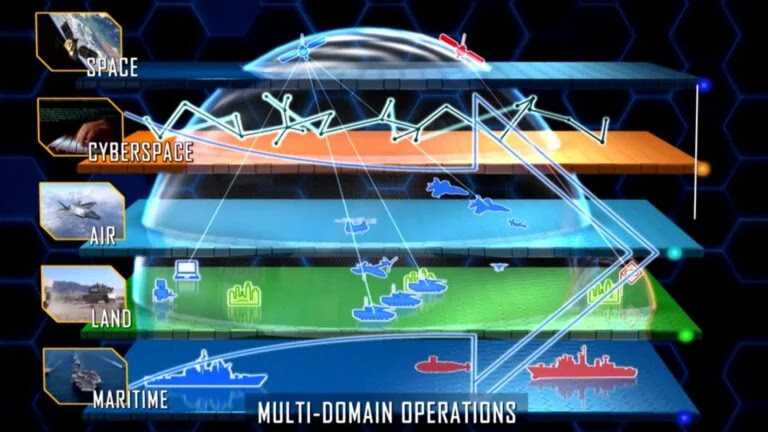
Multi-Domain Operations envisions a new collaboration across land, sea, air, space, and cyberspace (Army graphic)

Gray Eagle drones were armed with HELLFIRE missiles and GBU-69 glide bombs, 155mm artillery weapons fired rounds 60km (37.3 miles) to destroy SA-22 enemy air defenses and armored ground combat vehicles directly hit multiple T-72 tanks during the Army’s Project Convergence 2020 at Yuma Proving Grounds, Ariz.

The real story, however, according to senior Army leaders attending the service’s transformational combat experiment, was about data sharing, networked targeting and a cutting edge AI system called FIRESTORM.

“The bullet flying through the air and exploding is interesting, but that is not what is compelling about Project Convergence. It is everything that happens before the trigger is pulled. We did not come out here for a precision-fires exercise, what we came out here to do is increase the speed of information between sensing the target and passing that information to the effector,” Brig. Gen. Ross Coffman, Director, Next Generation Combat Vehicles Cross Functional Team, Army Futures Command, told reporters Sept. 23 at Yuma Proving Grounds.

FIRESTORM uses advanced computer algorithms to gather radio data link feeds, video stream data, navigational and terrain specifics, weather conditions, target coordinates and precisely identified enemy location information. FIRESTORM then uses AI-enabled computer processing to perform near real-time data analytics and compare all of these variables against a vast or seemingly limitless database. The various information streams are pooled together and analyzed in relation to one another to organize the data and identify the optimal weapon or "effector" needed for that particular target.

“FIRESTORM is a computer brain that recommends the best shooter, updates the common operating picture and enemy and friendly situations. It ‘missions’ the effectors that we want to eradicate the enemy on the battlefield. As enemy targets were identified on the battlefield, FIRESTORM quickly paired those targets with the best shooter in position to put effects on this,” Coffman said.

U.S. Army photo of the firing March 6 at Yuma Proving Grounds, Ariz. - file photo. (U.S. Army)

FIRESTORM can in part arrive at analytical conclusions in a mere instant, by weighing new information against previously compiled information. Machine learning happens when AI-enabled databases immediately assimilate new information that is entirely different than what is in the database. The pace at which this new information is discerned, analyzed and integrated comprises the fundamental value-added quality of AI.


Perhaps certain weapons such as artillery were proven effective for a certain range and target composition in particular weather conditions, at particular altitudes, with particular defenses and terrain configuration? The computer will analyze all of these variables both individually and in relation to one another against its database and pair the right weapon for the particular target engagement. This entire process can now take place in seconds, representing an exponential leap beyond previously achieved benchmarks of roughly 20minutes.


“This is happening faster than any human could execute,” Coffman said.


However, the system must be adaptable to new enemy threats. Once enemies encounter certain systems, they of course immediately move to counter them, therefore requiring developers to expedite quick improvements.

"We need code writers who will need to change algorithms to adjust to new threats. We can't wait 24 hours; we will have to change instantaneously to targets. We need to make decisions at speed and get ahead of the enemies’ decision cycle,” Lt. Gen. Michael Flynn, Director Army G3/5/7 told reporters.

Flynn further explained this “need for speed” in the context of the well-known Processing, Exploitation and Dissemination (PED) process that gathers information, distills and organizes it before sending carefully determined data to decision-makers. The entire process, long underway for processing things like drone video feeds for years, has now been condensed into a matter of seconds, in part due to AI platforms like FIRESTORM. Advanced algorithms can, for instance, autonomously sort through and observe hours of live video feeds, identify moments of potential significance to human controllers and properly send or transmit the often time-sensitive information.

"In the early days we were doing PED away from the front lines, now it's happening at the tactical edge. Now we need writers to change the algorithms,” Flynn explained.


“Three years ago it was books and think tanks talking about AI. We did it today,” McCarthy said.

Friday, May 29, 2020

How AI Will Soon Change Special Operations


When Gen. Richard D. Clarke was leading special operations forces in Afghanistan years ago, he spent 90 percent of his time thinking about moving and shooting — “the raid, the mission, the kill-capture mission, the destruction of enemy forces,” Clarke said last week at the annual SOFIC conference. But when he returned to Afghanistan last year as the commander of U.S. Special Operations Command, he found that U.S. leaders were focusing most of their mental energy on information.

Commanders now spend about 60 percent of their time mulling what the Taliban and the Afghan population are thinking, and how U.S. actions might influence that, Clarke said. “As we look at the info space and in our fight for competition…working in the information space can have the greatest impact in the coming years.”

Clarke said AI will play a big role in SOCOM’s future information-warfare efforts. This summer, the command will stand up a new office to harness AI for language translation, scanning captured laptops and cellphones, collating and countering Taliban messaging, and more.

“How can I, in real-time, sense what the enemy is stating publicly so we can counter that messaging,” he said, “so we can see what they’re working in the Twittersphere, or what they’re working in the information environment so that we can respond in real-time at the speed of relevance.”

That social information will also play a role in tactical operations. Next year, SOCOM will launch a program to give mission commanders better AI tools, according to James Smith, the command’s acquisition executive. One part is creating visualization software that can show relevant tactical information and what Smith described as “SOF-peculiar” data, such as population dynamics, social media trends, sentiment analysis and other social points. All this should give commanders a sense of what’s happening socially and psychologically in the places that they’re operating. 

Smith wants “to give our operations centers a much better feel for the operations that SOF is going to be asked to do, both the [countering violent extremism] operations but also in great power competition.” 

That information, along with “everything they currently get from a whole cell of analysts” will also flow to operators as part of a “hyper-enabled environment,” said Lisa Sanders, SOCOM’s director of science and technology for special operations forces, acquisition, technology and logistics. “All of that could be moved forward to give me a true, immediate situational picture on the edge.”

AI may also help special operators to overcome jamming or detect new electromagnetic threats. “Wouldn’t it be great if we had some kind of machine learning that just identified anomalies in this space,” Smith said. “Maybe it’s the new radars we haven’t seen before.”