Showing posts with label YPG. Show all posts

Thursday, October 6, 2022

U.S. Army Yuma Proving Ground hosts cutting edge artillery demonstration

In mid-September, YPG hosted a demonstration showcasing the use of the United States’ most cutting edge 155mm artillery munitions with the South Korean K9A1 Thunder Self-Propelled Howitzer and K10 Ammunition Resupply Vehicle (ARV). 


It has become well-known that U.S. Army Yuma Proving Ground (YPG) testing actively supports six of the Army Futures Command's Cross Functional Teams (CFTs) building the Army's future force.

In mid-September, YPG hosted a demonstration showcasing the use of the United States’ most cutting edge 155mm artillery munitions with the South Korean K9A1 Thunder Self-Propelled Howitzer and K10 Ammunition Resupply Vehicle.

Both platforms are manufactured by Hanwha Defense Corporation (HDC), South Korea’s largest defense contractor. Recently, the U.S. Army Combat Capabilities Development Command Armaments Center signed a Cooperative Research and Development Agreement (CRADA) with HDC to assess the feasibility, performance and capabilities of carrying and firing the American munitions by the two platforms.

“The purpose of our partnership is to check the compatibility of our munitions with those two vehicles,” said Sam Perez, who serves as principal investigator for the CRADA. “We’ve been working on this effort for the last year and a half to ensure we can safely fire the munitions from those two vehicles.”

On the demonstration day, about 60 visitors from across the Army and several friendly foreign nations observed the K9A1 undergo loading from the K10 and then embark on multiple realistic fire missions across two adjacent gun positions. The K9A1 demonstrated its ability to shoot and scoot, in which a self-propelled howitzer fires artillery, then immediately departs to a different location to evade possible counter-fire from an adversary. Weapons operators on board the howitzer also demonstrated the platform’s ability to burst fire three rounds within 16 seconds, and fire six rounds within 45 seconds. The K9A1 fired both XM1113 and M795 155 mm rounds, the former of which with rocket assistance. The testers also demonstrated the K10 capability of transferring the US Artillery munitions and inert Korean Modular Charge System to the K9A1.

“These are the things within the scope of work of the CRADA with Hanwha that they wanted to demonstrate in terms of the capabilities,” said Anthony Sebasto, Acting Director of Combat Capabilities Development Command’s Armaments Center at Picatinny Arsenal. “While the systems were here, they also wanted to have the opportunity to show the US and other foreign nations the capability of their system.”

Preparing for the demonstration took months of test planning and coordination, even prior to a pre-demonstration test in July that involved every scenario the visitors saw in September. Weapons operators from YPG and South Korea both participated.

“We did some safety testing leading up to this demonstration event to collect data to prove out the compatibility and safety for the crew since they are doing on-board operations,” said Jered Ford, YPG Artillery and Mine Branch Chief. “It’s not easy to work on the technical test side with the planning and preparations involved in that on top of the logistics of many visitors coming together at a gun position.”

“There were several tests that we had to do just to ensure the safety of the South Korean crew that did the man-firing,” added Jonathan Bazua, the YPG test officer who ran the event. “There was a lot of pre-demo work that had to be done to accomplish the actual demonstration safely. You’ve got to get a lot of small details right to make everything work.”

Following the demonstration, the DEVCOM personnel gave high marks to the support they received from YPG.

The K9A1 is used by nine other nations in addition to South Korea, and more may acquire the platform in the future.

“There will be opportunities for countries that are acquiring the K9A1 to see that the U.S. munitions are compatible with the system,” said Perez. “This is just the beginning of our collaborative efforts. There is the potential for more demonstrations like this in the future at Yuma Proving Ground.


Via www.army.mil


Wednesday, November 10, 2021

Pratt Miller and QinetiQ's RCV-L EMAV

 The soldiers of the 82nd Airborne Div. test Expeditionary Modular Autonomous Vehicle (EMAV) (Pratt Miller and QinetiQ's RCV-L) as a practice exercise in preparation for Project Convergence 21 at Yuma Proving Ground, Ariz.


Thursday, October 14, 2021

US Army tests XM1113ER projectile for its Extended Range Cannon Artillery (ERCA)

General Dynamics’ Innovative Rocket-Assisted Projectile Exceeds 70-Kilometer Milestone Range in Demonstration.


Designed for the U.S. Army’s future Extended Range Cannon Artillery system, XM1210 (XM1113ER). It was showcased at the General Dynamics-OTS exhibit for the Association of the United States Army’s (AUSA) annual conference Oct. 11-13 in Washington D.C.


ST. PETERSBURG, Fla. – General Dynamics Ordnance and Tactical Systems (OTS) successfully tested four XM1210 (XM1113ER) High Explosive Rocket-Assisted Projectiles that demonstrated a range capability in excess of 70 kilometers for the Army’s future Extended Range Cannon Artillery (ERCA) system.

The key milestone was achieved Oct. 2 at the Yuma Proving Ground, Arizona. The XM1210 (XM1113ER) projectile is a critical component of the Army’s Long-Range Precision Fires modernization program that aims to create windows of opportunity for the joint force to penetrate an enemy’s anti-access, area denial (A2AD) network.


The ERCA system during the M982A1 Excalibur round test-fire. Details on the link - U.S. Army’s ERCA Cannon Shoots M982 Excalibur Rounds to 70 km in Latest Demo


“Having the ability to reliably deliver mass fires at extended ranges with precision will revolutionize the modern battlefield, so we’re thrilled the XM1210 (XM1113ER) is meeting the Army’s requirements,” said Jason Gaines, vice president and general manager, General Dynamics-OTS Munition Systems. “It’s an honor for our team to work side-by-side with our U.S. government customers and industry partners to further our mission of delivering lethal and precise capability at 70 kilometers by 2023.”

The XM1210 (XM1113ER) uses cutting-edge technology to extend the range of a 155mm artillery round. The innovative munition combines guidance capability with warhead lethality to form a more affordable solution for the Army’s ERCA system. Providing a range of more than 40 kilometers from a 39-caliber cannon and more than 70 kilometers from a 58-caliber cannon, the projectile improves protection for the artillery warfighter by increasing stand-off distance from enemy fire.

Tuesday, May 11, 2021

Latest iteration of M1 Abrams main battle tank wraps up testing at Cold Regions Test Center

By Mark Schauer


What has outstanding offensive and defensive capability and represents the aweing tip of the spear in a major land war?

It’s the M1A2 System Enhancement Package (SEP) version 3 (v3) main battle tank, which wrapped up extensive coldweather testing at U.S. Army Cold Regions Test Center (CRTC) this winter to ensure it functions as it should wherever in the world it could be called on to serve.

Since testing at the Department of Defense’s lone extreme cold natural environment testing facility began in January 2020, the SEPv3 was driven more than 2,000 miles in rugged conditions across three seasons of sub-Arctic weather, fired hundreds of rounds for accuracy in extreme cold, and underwent testing of its auxiliary power unit, as well as numerous other sub-systems.

The list of improvements to test in the SEPv3 is lengthy: improved fire control electronics mean the SEPv3’s gun can shoot faster and more accurately; the armor has been improved; it can even utilize hubcaps and road arms manufactured with a 3D printer. Onboard diagnostics are much more robust, and technical manuals can be accessed from removable screens.

Though the platform was extensively tested at Yuma Test Center prior to being put through its paces in Alaska, the sub-zero temperatures brought forth glitches that would have been unimaginable in the desert.

“While we were doing the main weapon firing, we ran into a system issue where we weren’t able to fire,” said Elissa Palm, test officer. “After some pretty extensive troubleshooting, we were able to work with the product manager to identify a fix. We were able to prevent non-mission capable tanks from being fielded and implemented the fix across the fleet, then validated here with additional testing.”

Conducting evaluations in the extreme cold of an interior Alaskan winter usually brings unexpected challenges even for the rugged professionals of CRTC, and this test was no different. One night, overflow ice from the nearby Delta River flooded the gun position, then quickly refroze rock-solid.

“We had one of the portable latrines with ice that was hip-high: you weren’t going to move it until it got melted,” said Greg Netardus, Chief of CRTC’s Test Operation’s Division. “All of the equipment was frozen in: wheeled vehicles carrying the ammunition would not have been able to maneuver down there. It was not safe to put people down here.”

CRTC’s vast expanse includes other ranges that could be utilized, but not ones that had important infrastructure that the testers needed.

Since testing began in January 2020, the SEPv3 was driven more than 2,000 miles in three seasons of sub-Arctic weather, fired hundreds of rounds, and underwent testing of its auxiliary power unit, as well as numerous other sub-systems. (Photos by Sebastian Saarloos)


“We don’t have multiple ready to fire ranges with targets at known distances for the tank, so our Allied Trades shop did a really nice job in a very short time building a new mobile target based on a Conex and getting it set up for us,” said Palm.

The target that CRTC’s Allied Trades shop had to recreate on the fly consisted of tall poles upon which a target is pulled into place with a hand crank. The fixed target is emplaced in the ground, which required approvals for work and brush clearance prior to construction.

“We used a 40-foot ISO container as a base, so there was no dirt work or anchoring required,” said Sam Porter, CRTC’s Allied Trades Lead. “An ISO container meant we could build it offsite in the shop, where we had cranes and a man lift. We took the design of the target that was in place and modified it.”

The mobile target was re-used in the summer, and provides a flexible new capability for future tests.

“With this, they should be able to set it up and utilize wherever they are able to fire that gun,” said Porter.

To take advantage of the coldest temperatures possible, weapons firings were oftentimes conducted in the small hours of the morning. Possibly the most difficult testing challenge, however, occurred earlier in the calendar year: when the COVID crisis hit in March 2020, eight members of the testing team who had come to CRTC from Yuma were especially impacted by sudden restrictions in travel and new temporary duty (TDY) authorizations.

“A lot of times on these long-term tests, we like to trade people in and out so they can get back to their families,” said Palm. “This time it was really hard for us to get TDY approvals, so the crew was great in that most of them volunteered to stay until the end of the effort.”

The M1 and its variants have been tested at U.S. Army Yuma Proving Ground and its constituent test centers for more than 40 years, and likely will continue to be for as long as the system remains in the ground combat arsenal. This testing has played a vital role in keeping the M1 the most capable tank in the world.

Via "The Outpost" newspaper

ERCA autoloader’s speed tested at YPG

The Extended Range Cannon Artillery (ERCA) weapon system has demonstrated it can get the job done. In previous tests and demonstrations, the ERCA has fired twice as far as any currently fielded Army cannon and has proven to fire pre-loaded rounds from a limited capacity autoloader magazine 2-3 times as fast as a gun crew. The autoloader’s speed was demonstrated once again during a test March 30 at Yuma Proving Ground (YPG).


The Extended Range Cannon Artillery autoloader speed was demonstrated during a test March 30 at U.S. Army Yuma Proving Ground. (Photo by Ana Henderson)

The autoloader, designed by the Army Futures Command’s (AFC) Armament Center at Picatinny Arsenal, performs cannon loading tasks mechanically – setting the fuze, loading the projectile, propellant and stub charge, closing the breech – in sequence with barrel pointing to enable cannon firing at unprecedented rates.

Army Future’s Command Brig. Gen. John Rafferty Director of the Long Range Precision Fires (LRPF) Cross Functional Team (CFT) traveled to YPG to see the demonstration first hand and to meet the team who is behind all the work.

He told the team, “The Army is watching what you are doing and they are impressed.”

That team consists of the Yuma Test Center (YTC) workforce at YPG, Armament Center employees from Picatinny Arsenal, N.J. and Watervliet Arsenal, N.Y, and Project Manager Combat Ammunitions Systems employees, also from Picatinny Arsenal.

The demonstration involved the Armament Center’s 31-round fullcapacity autoloader using different types of charges, and the goal was to obtain data on how to increase the rate-of-fire in ERCA, and to verify the technical maturity of the major autoloader system subcomponents: projectile magazine, propellant magazine and transfer mechanism.

Rafferty explained, “We know that eventually we are going to have to improve the rate-of-fire of the system to deliver lethality against our adversaries in the volume that we need but also increase the survivability of our Soldiers and system. Allowing them to shoot quickly and move — because as soon as we put an ERCA battalion on the battlefield they will become the enemy’s number one priority target because the capability that it delivers is so significant.”

Chris Smith, Cannon Integrated Product Team Lead from the Armaments Center, whose team is in charge of cannon performance, added “With artillery when you are manually loading it, they can do it quickly in the beginning but then they get tired it slows down. This automated process will help keep that rate going by taking the user out of it and also keeps them safe.”

The demonstration involved the 31-round full-capacity autoloader using different types of charges, and the goal was to obtain data on how to increase the rate-of-fire. (Photos by Ana Henderson)

After viewing the inner workings of the weapon system, Rafferty along with YPG and YTC leadership and the ERCA teams viewed the live firing of three inert rounds from inside of blast protected workspaces at the gun position.

There was little time between each round and the work was, “Seamless” said Smith, “Today was very successful. Today’s demonstration was a culmination of a lot of hard work by the Armament Center and the industry partners to assemble and demonstrate an autoloader for ERCA against the requirements that were given a few years ago,” explained Senior Executive Service Anthony Sebasto, Armaments Center Executive Director for Enterprise and Systems Integration Center.

Rafferty told the crews on site, “With what we saw today, I don’t know how you could not be incredibility impressed.”

Now the data collected from this demonstration will be reviewed, analyzed and applied to the system.

“Today we demonstrated the firing rate. It gave the Army one more data point in terms of building confidence in ERCA ammunition handling capabilities and possibilities for the future,” said Sebasto.

Rafferty explained, “We are going to get range and lethality first and then when we are ready we’ll increase the rate-of-fire.”

Soon what was learned during this demonstration will be put into action once again with higher stakes.

“We are on the right path. The combination of the propellant magazine, the projectile magazine, and the transfer mechanism is really magical to see in action. It’s an early effort that is going to mature into a 23-round system that is going to be demonstrated late this year,” said Rafferty.


Gen. John Rafferty is pictured talking with Jered Ford during a recent visit. Ford has worked at Yuma Proving Ground for 14 years and is currently the Artillery Branch Chief. (Photo by Ana Henderson). On the background is the ХМ1299 ERCA with the new autoloader.


Via "The Outpost" newspaper

Thursday, December 24, 2020

70 kilometer precision-guided artillery shot at U.S. Army YPG (video)

The first successful test of a 70 km (43 miles) shot with a precision-guided munition took place on December 19, 2020 at U.S. Army Yuma Proving Ground.


Courtesy Video U.S. Army Yuma Proving Ground

The live fire demonstration used the Excalibur projectile and was the culmination of a campaign of learning on multiple systems.

In this test, the Army took three shots. The first shot came up short due to very high head winds at a high altitude and the second shot had a hardware failure, but the third shot proved that the service is getting closer to dialing in on the right balance between propellant, projectile design and other factors that play into achieving greater distances, Rafferty said.

“This demonstration is not a destination,” Col. Tony Gibbs, the Army’s program manager for combat artillery system, told reporters. “This is really just a waypoint in our ongoing campaign of learning as we work to really realign U.S. supremacy in cannon artillery. It’s definitely a big knowledge point for us today.”

Each munition fired during Saturday’s event had slight design differences to address how best to design and prepare the round to absorb the high-pressure and force of being fired at 1,000 meters per second from a gun tube of ERCA’s caliber, Rafferty said.

“What was consistent was the propellant configuration,” he added. “So we got that propellant configuration, I think dialed in really close down, which is great.”

The first shot, due to the winds, fell short by roughly 100 meters, which, Rafferty said, sounds like a lot, but is closer when considering when the munition has to travel 70,000 meters. The Army knew the first shot would come up short due to wind, but wanted to take it anyway in order to learn from it.

The second shot, the Army had modified the hardware configuration and experience a hardware failure, Gibbs confirmed. Specifically, the Army added an isolator for the inertial measurement unit, which is essentially a shock absorber to counter the pressure spike in the chamber.


US Army used as target the Transporting-loading vehicle 2T7M of Kub-M1 SAM system

Tuesday, September 29, 2020

US Army has a SkyNet

Via FoxNews

US Army has a SkyNet - it's a data sharing and cutting-edge AI system called FIRESTORM


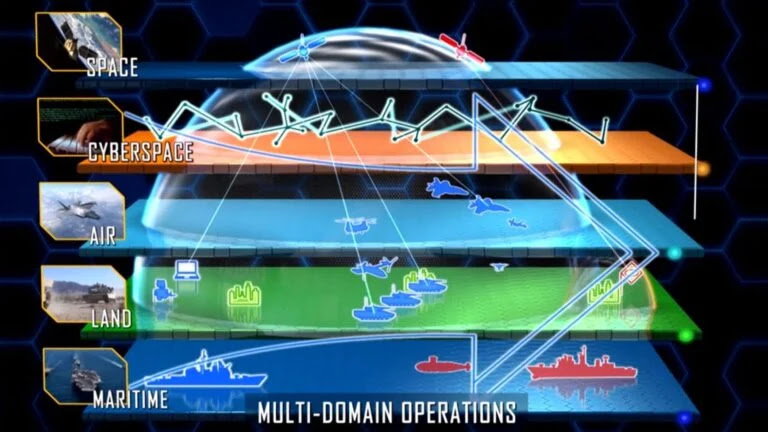
Multi-Domain Operations envisions a new collaboration across land, sea, air, space, and cyberspace (Army graphic)

Gray Eagle drones were armed with HELLFIRE missiles and GBU-69 glide bombs, 155mm artillery weapons fired rounds 60km (37.3 miles) to destroy SA-22 enemy air defenses and armored ground combat vehicles directly hit multiple T-72 tanks during the Army’s Project Convergence 2020 at Yuma Proving Grounds, Ariz.

The real story, however, according to senior Army leaders attending the service’s transformational combat experiment, was about data sharing, networked targeting and a cutting edge AI system called FIRESTORM.

“The bullet flying through the air and exploding is interesting, but that is not what is compelling about Project Convergence. It is everything that happens before the trigger is pulled. We did not come out here for a precision-fires exercise, what we came out here to do is increase the speed of information between sensing the target and passing that information to the effector,” Brig. Gen. Ross Coffman, Director, Next Generation Combat Vehicles Cross Functional Team, Army Futures Command, told reporters Sept. 23 at Yuma Proving Grounds.

FIRESTORM uses advanced computer algorithms to gather radio data link feeds, video stream data, navigational and terrain specifics, weather conditions, target coordinates and precisely identified enemy location information. FIRESTORM then uses AI-enabled computer processing to perform near real-time data analytics and compare all of these variables against a vast or seemingly limitless database. The various information streams are pooled together and analyzed in relation to one another to organize the data and identify the optimal weapon or "effector" needed for that particular target.

“FIRESTORM is a computer brain that recommends the best shooter, updates the common operating picture and enemy and friendly situations. It ‘missions’ the effectors that we want to eradicate the enemy on the battlefield. As enemy targets were identified on the battlefield, FIRESTORM quickly paired those targets with the best shooter in position to put effects on this,” Coffman said.

U.S. Army photo of the firing March 6 at Yuma Proving Grounds, Ariz. - file photo. (U.S. Army)

FIRESTORM can in part arrive at analytical conclusions in a mere instant, by weighing new information against previously compiled information. Machine learning happens when AI-enabled databases immediately assimilate new information that is entirely different than what is in the database. The pace at which this new information is discerned, analyzed and integrated comprises the fundamental value-added quality of AI.


Perhaps certain weapons such as artillery were proven effective for a certain range and target composition in particular weather conditions, at particular altitudes, with particular defenses and terrain configuration? The computer will analyze all of these variables both individually and in relation to one another against its database and pair the right weapon for the particular target engagement. This entire process can now take place in seconds, representing an exponential leap beyond previously achieved benchmarks of roughly 20minutes.


“This is happening faster than any human could execute,” Coffman said.


However, the system must be adaptable to new enemy threats. Once enemies encounter certain systems, they of course immediately move to counter them, therefore requiring developers to expedite quick improvements.

"We need code writers who will need to change algorithms to adjust to new threats. We can't wait 24 hours; we will have to change instantaneously to targets. We need to make decisions at speed and get ahead of the enemies’ decision cycle,” Lt. Gen. Michael Flynn, Director Army G3/5/7 told reporters.

Flynn further explained this “need for speed” in the context of the well-known Processing, Exploitation and Dissemination (PED) process that gathers information, distills and organizes it before sending carefully determined data to decision-makers. The entire process, long underway for processing things like drone video feeds for years, has now been condensed into a matter of seconds, in part due to AI platforms like FIRESTORM. Advanced algorithms can, for instance, autonomously sort through and observe hours of live video feeds, identify moments of potential significance to human controllers and properly send or transmit the often time-sensitive information.

"In the early days we were doing PED away from the front lines, now it's happening at the tactical edge. Now we need writers to change the algorithms,” Flynn explained.


“Three years ago it was books and think tanks talking about AI. We did it today,” McCarthy said.

Tuesday, July 28, 2020

Private company tests ballistic orbital space access, new propellant at U.S. Army Yuma Proving Ground

YUMA PROVING GROUND, Ariz.-- The world record for the highest altitude artillery shot—which reached past the Karman Line into space-- was set at U.S. Army Yuma Proving Ground (YPG) in 1966.


The world record for the highest altitude artillery shot was set at U.S. Army Yuma Proving Ground in 1966 and proved the concept of ballistic suborbital space access. The idea of using artillery as a low-cost alternative to rockets to launch payloads into Earth orbit lives on with a private industry customer called Green Launch conducting testing here to launch a projectile into space with an innovative new hydrogen and oxygen gas propellant. Preparations are underway to fire vertically into space at YPG later this year: the projectile will land about 20 kilometers downrange from its firing point, which is easily accomplished within YPG’s 1,200 square miles of land area and 2,000 square miles of restricted airspace that in places reaches to outer space.

The test fire more than 50 years ago proved the concept of ballistic suborbital space access, but funding for the program was cancelled the following year.

Yet the idea of using artillery as a low-cost alternative to rockets to launch payloads into Earth orbit lives on. Currently, a private industry customer called Green Launch is conducting testing here to launch a projectile into space with an innovative new propellant technology.
Using a hydrogen and oxygen gas propellant whose only byproduct is water vapor, the company has achieved four mega joules of energy with horizontal fires at YPG, and approached the velocities reached in the vertical shot that set the world record in 1966.

“Last year, we launched a three kilogram test projectile at about 1.6 kilometers per second,” said Brad Tower, Green Launch CEO. “It proved our ignition system and we discovered some challenges with our release mechanism.”

The successful shot that propelled the payload at nearly Mach Five resulted in more venture capital, and the team believes that later this year it will achieve the same velocities as the record-breaking shot. At present the team is firing horizontally into a newly-constructed catch box, and preparations are underway to fire vertically at YPG later this year. For these shots, the team will utilize their newly-constructed hydraulic gun mount, which will allow them to elevate the barrel to the necessary 87 degree angle.

“We are getting ready to test where we can go up to 20 to 22 mega joules, which will build up enough energy to get our vehicle to 105 to 110 kilometers of altitude.”

The projectile will land about 20 kilometers downrange from its firing point, which is easily accomplished within YPG’s 1,200 square miles of land area and 2,000 square miles of restricted airspace that in places reaches to outer space.

The test fires at YPG are meant to serve as a technology demonstration, said Tower. The final device will achieve 160 mega joules of energy, roughly eight times more powerful than what is being fired this year. Eventually, the company’s ambitions for the technology will force than to test elsewhere.

“Ultimately we want to go orbital, so that will require getting away from a landlocked facility like YPG. YPG has the unlimited vertical air space and a large enough range to get us into space and back down with a very, very high level of certitude that we would land back on the range, but if you want to get orbital, you have to have essentially unlimited downrange. We will probably end up somewhere in the South Pacific to do the kind of orbital shots we want to do.”

Tower says that using YPG as a test facility has greatly helped the start-up company in their efforts to rigorously control costs, and characterizes the support his team receives from YPG personnel as unparalleled.

“I don’t think we could do this anywhere else in the United States. We’ve gotten support all along that is incalculable in its value. These guys really put their back into it, and the professionalism has been exceptional.”

Monday, June 29, 2020

Evaluation test of different vehicles in Yuma Proving Ground

Evaluation test of different vehicles in Yuma Proving Ground

and very interesting vehicle is the LAV-25 with mounted NEMO turret


U.S. Army Yuma Proving Ground's test and evaluation mission takes place in the desert of Arizona, the Arctic cold of the Alaskan interior, and the tropical jungles of Central and South America. It has jurisdiction over all of the extreme weather testing in the Army, in the desert of Arizona and the Arctic cold of the Alaskan interior. 


Thursday, May 28, 2020

XM 1299 Prototype 0 Demonstration


In March 2020, U.S. Army Yuma Proving Ground demonstrated a dramatic stride in extending the range and precision of artillery fires in a demonstration attended by some of the Army’s highest-ranking officials, as well as members of the local and national media who watched both in person and via video feeds at the Pentagon and Fort Sill, Oklahoma.


The visitors witnessed two separate test fires of both the Excalibur precision guided munition and the XM1113 rocket-assisted high explosive projectile from a Prototype 0 XM 1299 self-propelled howitzer. Both Excalibur projectiles achieved a 65 kilometer precision hit, and both XM 1113 projectiles achieved a 65 kilometer range. The performance of the XM 1299, outfitted with a 58 caliber tube on a PIM chassis with loader assist, was the centerpiece of the test.