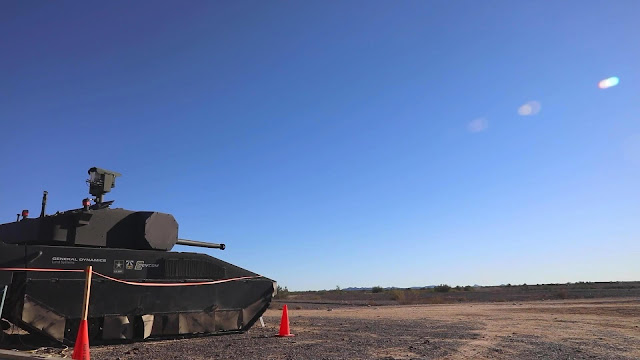
The US Army"s Griffin ATLAS with integrates new gyro-stabilized Thermal Sighting Unit (TSU) conduct live fire exercise during Project Convergence 21.
A Stryker/LAV-700 fitted with ALAS-MC turret conduct live fire exercise
As i walk through the valley of the shadow of death, I have no fear because I am the baddest motherfucker in whole valley.
The US Army"s Griffin ATLAS with integrates new gyro-stabilized Thermal Sighting Unit (TSU) conduct live fire exercise during Project Convergence 21.
A Stryker/LAV-700 fitted with ALAS-MC turret conduct live fire exercise
Designed for the U.S. Army’s future Extended Range Cannon Artillery system, XM1210 (XM1113ER). It was showcased at the General Dynamics-OTS exhibit for the Association of the United States Army’s (AUSA) annual conference Oct. 11-13 in Washington D.C.
ST. PETERSBURG, Fla. – General Dynamics Ordnance and Tactical Systems (OTS) successfully tested four XM1210 (XM1113ER) High Explosive Rocket-Assisted Projectiles that demonstrated a range capability in excess of 70 kilometers for the Army’s future Extended Range Cannon Artillery (ERCA) system.
The key milestone was achieved Oct. 2 at the Yuma Proving Ground, Arizona. The XM1210 (XM1113ER) projectile is a critical component of the Army’s Long-Range Precision Fires modernization program that aims to create windows of opportunity for the joint force to penetrate an enemy’s anti-access, area denial (A2AD) network.
“Having the ability to reliably deliver mass fires at extended ranges with precision will revolutionize the modern battlefield, so we’re thrilled the XM1210 (XM1113ER) is meeting the Army’s requirements,” said Jason Gaines, vice president and general manager, General Dynamics-OTS Munition Systems. “It’s an honor for our team to work side-by-side with our U.S. government customers and industry partners to further our mission of delivering lethal and precise capability at 70 kilometers by 2023.”
The XM1210 (XM1113ER) uses cutting-edge technology to extend the range of a 155mm artillery round. The innovative munition combines guidance capability with warhead lethality to form a more affordable solution for the Army’s ERCA system. Providing a range of more than 40 kilometers from a 39-caliber cannon and more than 70 kilometers from a 58-caliber cannon, the projectile improves protection for the artillery warfighter by increasing stand-off distance from enemy fire.
The autoloader, designed by the Army Futures Command’s (AFC) Armament Center at Picatinny Arsenal, performs cannon loading tasks mechanically – setting the fuze, loading the projectile, propellant and stub charge, closing the breech – in sequence with barrel pointing to enable cannon firing at unprecedented rates.
Army Future’s Command Brig. Gen. John Rafferty Director of the Long Range Precision Fires (LRPF) Cross Functional Team (CFT) traveled to YPG to see the demonstration first hand and to meet the team who is behind all the work.
He told the team, “The Army is watching what you are doing and they are impressed.”
That team consists of the Yuma Test Center (YTC) workforce at YPG, Armament Center employees from Picatinny Arsenal, N.J. and Watervliet Arsenal, N.Y, and Project Manager Combat Ammunitions Systems employees, also from Picatinny Arsenal.
The demonstration involved the Armament Center’s 31-round fullcapacity autoloader using different types of charges, and the goal was to obtain data on how to increase the rate-of-fire in ERCA, and to verify the technical maturity of the major autoloader system subcomponents: projectile magazine, propellant magazine and transfer mechanism.
Rafferty explained, “We know that eventually we are going to have to improve the rate-of-fire of the system to deliver lethality against our adversaries in the volume that we need but also increase the survivability of our Soldiers and system. Allowing them to shoot quickly and move — because as soon as we put an ERCA battalion on the battlefield they will become the enemy’s number one priority target because the capability that it delivers is so significant.”
Chris Smith, Cannon Integrated Product Team Lead from the Armaments Center, whose team is in charge of cannon performance, added “With artillery when you are manually loading it, they can do it quickly in the beginning but then they get tired it slows down. This automated process will help keep that rate going by taking the user out of it and also keeps them safe.”
The demonstration involved the 31-round full-capacity autoloader using different types of charges, and the goal was to obtain data on how to increase the rate-of-fire. (Photos by Ana Henderson)
After viewing the inner workings of the weapon system, Rafferty along with YPG and YTC leadership and the ERCA teams viewed the live firing of three inert rounds from inside of blast protected workspaces at the gun position.
There was little time between each round and the work was, “Seamless” said Smith, “Today was very successful. Today’s demonstration was a culmination of a lot of hard work by the Armament Center and the industry partners to assemble and demonstrate an autoloader for ERCA against the requirements that were given a few years ago,” explained Senior Executive Service Anthony Sebasto, Armaments Center Executive Director for Enterprise and Systems Integration Center.
Rafferty told the crews on site, “With what we saw today, I don’t know how you could not be incredibility impressed.”
Now the data collected from this demonstration will be reviewed, analyzed and applied to the system.
“Today we demonstrated the firing rate. It gave the Army one more data point in terms of building confidence in ERCA ammunition handling capabilities and possibilities for the future,” said Sebasto.
Rafferty explained, “We are going to get range and lethality first and then when we are ready we’ll increase the rate-of-fire.”
Soon what was learned during this demonstration will be put into action once again with higher stakes.
“We are on the right path. The combination of the propellant magazine, the projectile magazine, and the transfer mechanism is really magical to see in action. It’s an early effort that is going to mature into a 23-round system that is going to be demonstrated late this year,” said Rafferty.
Gen. John Rafferty is pictured talking with Jered Ford during a recent visit. Ford has worked at Yuma Proving Ground for 14 years and is currently the Artillery Branch Chief. (Photo by Ana Henderson). On the background is the ХМ1299 ERCA with the new autoloader.
Via "The Outpost" newspaper
Development of the ERCA autoloader capability is notable because it would enable the cannon to fire at significantly faster rates, enhance lethality, and it may set the stage for future “optionally manned” artillery battery configurations where fewer – or possibly no Soldiers – would be required at the cannon during firing operations.
ERCA from the turret bearing up is a 100-percent Armaments Center-developed system. The ERCA armament and munitions have been thought about and innovation applied to them by the engineers at the Armaments Center for the XM1299, which gets’ you the range, and XM1299E1, which gets you the rate of fire capability.
The ERCA effort is nested within the Army’s top Modernization Priority, Long Range Precision Fires (LRPF). The Long Range Precision Fires Cross Functional Team (CFT) has set plans in motion for a two phased capability improvement by first providing the Soldier a self-propelled howitzer with increased range, followed by an increase to rate-of-fire. The U.S. Army Combat Capabilities Development Command (DEVCOM) Armaments Center at Picatinny Arsenal, N.J., is leading the ERCA design effort.
Cannon loading requires selecting the right type of projectile and fuze to deliver the desired effect to the target and selecting the right propellant to match the required distance. First, the fuze is set. Next, the projectile and then the charge are loaded into the cannon’s tube, the breech is closed and the cannon is ready to fire.
The autoloader is a machine that performs these well-orchestrated tasks, which have historically been performed by cannon crew members. The autoloader, however, can attain a rate of fire that is 2-3 times faster than a cannon crew, with limits to duration such as the cannon tube overheating, according to Armaments Center Project Engineer and ERCA Ammunition Handling System Lead, Jimmy Lee.
In November 2018, an earlier variant of the ERCA, the XM1299 howitzer, fired projectiles out to 72 kilometers at Yuma, the farthest-reaching shots ever made by U.S. Army howitzers, and more than double the reach of currently fielded Army artillery systems.
In the demonstration in June 2019, an early science and technology ERCA prototype outfitted with a limited capacity autoloader, loaded five mass simulator high velocity projectiles and five prototype XM657 Extended Range Supercharge propellant charges, and successively fired a five-round cannon “burst” downrange at a rate of seven-rounds-per-minute. The purpose of the demonstration was to inform development of the ERCA XM1299E1 according Armaments Center Project Officer for ERCA, Josiah Fay.
The limited capacity autoloader was designed to handle only one type of projectile and charge, and it worked with a limited capacity magazine, according to Lee. It was built to validate key aspects of the engineering approach during the march toward the objective autoloader, and the tests allowed the team to verify that key components would work as intended in realistic conditions, while close observation of its performance would inform future autoloaders.
Next up, according to Lee, was building and demonstrating the objective capacity autoloader, which will be able to load and manage a suite of the Army’s legacy and emerging fuzes, propellant charges and projectiles, and it will work with larger capacity magazines. It is a more complex machine because projectiles, fuzes and propellant charges come in different shapes, sizes, and weights, which requires the autoloader to handle a range of configurations to execute a fire mission.
Also, the newer autoloader must deliver at a higher rate while working in synchronization with the larger magazines, which store and manage the loads so that it will deliver the right combination of fuze, projectile and propellant for the fire mission.
The Armaments Center engineers are working at Picatinny with an industry partner via an Other Transaction Agreement contract vehicle to attain the desired ammunition handling capability. The industry partner develops the magazines while working in coordination with the Armaments Center’s autoloader development team.
The Autoloader and Other ERCA Objectives
The ERCA system’s development emerged as a formal research effort – known as a “STO” for Science and Technology Objective – following a 2013 study that assessed next-generation artillery. According to Lee, the main takeaway from the onset of the effort was that significantly increased range coupled with increased rates of fire was technologically within reach, and it would be a “game changer” for cannon artillery.
Lee added that a significant capability of the autoloader was that it portends future artillery battery configurations where a howitzer would perform fire missions without necessarily requiring that Soldiers be in the vehicle during the firing operations.
Along with the autoloader, prominent elements of the ERCA program include the XM1113 Rocket Assist Projectile and XM659 Stub Charge, which have been formally transitioned and are now managed by Project Manager Combat Ammunition Systems (PM CAS). There are also several versions of the “Supercharge” in various stages of development to support an increased range capability.
The cannon features a sliding block breech built to withstand the immense pressure of the supercharge and a cannon tube made with new alloys formed to a 30-foot length, which enables a projectile’s velocity to continue increasing inside the cannon tube before exiting.
The ERCA armaments are fitted on an M109A7 “Paladin” chassis to form the self-propelled ERCA system.
The Joint Program Executive Office Armaments & Ammunition Project Manager Combat Ammunition Systems (PM CAS) conducted the first successful test of a 70 km (43 miles) shot with a precision-guided munition, Dec. 19, at Yuma Proving Ground.
The ERCA program is investigating and developing technology to extend the range of the Army’s current 155mm self-propelled howitzer (SPH), the M109.
The prototype ERCA howitzer (XM1299) consists of a BAE Systems’ M109A7 Paladin Integrated Management (PIM) howitzer chassis equipped with an Army-developed 58-caliber, 30-foot gun barrel in place of M109A7’s original 39-caliber barrel.
In July 2019, BAE Systems was awarded a $45 million contract by the Army for the ERCA Increment 1 prototype, which saw the company integrating the Army-developed ERCA onto the M109A7 chassis. The U.S. Army is reportedly on contract with BAE Systems for 18 ERCA howitzers with the fielding expected to begin in FY2023.
The live fire demonstration used the Excalibur projectile and was the culmination of a campaign of learning on multiple systems.
“Not only did the test show the design robustness of a current fielded projectile to demonstrate lethality at extended ranges, it did so while maintaining accuracy, marking a major milestone in support of (Long Range Precision Fires) objectives of achieving overmatch artillery capability in 2023,” said Col. Anthony Gibbs, Project Manager for Combat Ammunition Systems.
Providing longer range than that of potential adversaries, is a significant combat multiple for maneuver commanders and the Long Range Precision Fires Cross Functional Team (LRPF-CFT) was established to tackle that objective. Their mission includes increasing lethality, improving rates of fire, and enabling deep fires to shape the battlefield and set conditions for the brigade combat team close fight. Multiple efforts including new propellant charges, an Extended Range Cannon Artillery (ERCA) system, multiple projectiles with varying capabilities, and target identification and tracking systems, are under development to increase range and reduce the time from target identification to effects on target.
The Excalibur 70 km demonstration is signaled as the first step to regaining U.S. supremacy in cannon artillery by 2023. For more than 15 years, the M982A1 Excalibur projectile has been the premier precision artillery munition in the U.S. arsenal. The projectiles reliability, robust structural design and the ability to course correct while maintaining both precision and accuracy were leveraged to achieve 70 km range during the test.
Throughout initial development and multiple years of operational use, Excalibur subsystems were proven to be effective with the current 39 caliber gun systems in the M109A6/A7 Self-Propelled Howitzer and M777A2 Towed Howitzer fleets. However, the increased pressure to achieve the muzzle velocity required for 70 km range from the longer 58 caliber ERCA cannon created harsher environments, so the major focus became maintaining flight stability and safety.
“Testing in late 2019 revealed that the warhead used in Excalibur had sufficient margin to survive this higher gun launch environment,” said Gibbs. “The team learned that the effects of the new system and its associated harsher environments on the projectile had reduced or eliminated some of the design margin that existed with the legacy systems.”
The design team of U.S. Government and contractor engineers analyzed the individual subsystems’ operating margins, their structural integrity and their safety margins in order to assure that the ammunition would be safe and effective in the new ERCA System. Together with support from the Munitions and Weapons Division at the Army Test and Evaluation Command Yuma Test Center, PM CAS, and these technical experts from Raytheon, their subcontractors and the Combat Capabilities Development Command Armaments Center completed the necessary research and testing to reduce the risk and make the Excalibur 70 km demonstration possible.
“Today’s demonstration marks a significant step forward in filling a capability gap in our Army of accurately reaching out to 70 km with cannon artillery. It’s the product of tremendous teamwork and initiative by multiple organizations and our industry partners to bring new technology to our artillery forces and regain overmatch with our adversaries,” said Brig. Gen. John Rafferty, LRPF-CFT director.
By leveraging the robust design of the current Excalibur, a GPS coordinate-seeking projectile with a circular error probable of less than two meters, it also represents a low-investment, high-payoff approach to meeting objectives in support of the Army’s top modernization priority. Development efforts will add a seeker able to identify and engage moved or moving targets and differentiate between military and civilian vehicles. Future upgrades may also enable the projectile to identify friend or foe and to communicate between projectiles in flight to reduce multiple projectiles engaging the same target during volley fire. The LRPF-CFT modernization of U.S. Artillery Forces is poised to deliver overmatch and the evolution of Excalibur continues to incorporate cutting edge technologies that provide increased capabilities in support of the Field Artillery mission.
Weight and mobility issues have forced the U.S. Army to abandon a government-developed autoloader for its Extended Range Artillery (ERCA) program, and the service now needs the help of six technology companies.
Brigadier General John Rafferty, Head of the Inter-Functional Long Range Precision Shooting Team, spoke at the Sept. 29 virtual conference on fires and provided an update on his programs. A notable change is the decision of the army not to produce an automatic loader, which it was developing for a new weapon based on the BAE Systems Paladin M109A7 self-propelled howitzer.
“The integration challenge for [this] was too much of a trade-off with mobility and durability, and some of the 3000 mile run results on the combat vehicle [at Yuma's Proving Grounds] were related to the center of gravity problem we had,” one-star general. "It was easy to say that we cannot do this."
Instead, the Army is turning to a group of six companies previously selected to help find solutions to resupply artillery ammunition - Actuate, Apptronik, Carnegie Robotics, Hivemapper, Neya Systems and Pratt Miller. While Brigadier General Rafferty did not provide exhaustive information on the path ahead, he noted that a future opportunity might not be an autoloader at all.
Source US Army scraps ERCA autoloader plans, heads back to the drawing board