Showing posts with label UGV. Show all posts

Wednesday, November 10, 2021

Pratt Miller and QinetiQ's RCV-L EMAV

 The soldiers of the 82nd Airborne Div. test Expeditionary Modular Autonomous Vehicle (EMAV) (Pratt Miller and QinetiQ's RCV-L) as a practice exercise in preparation for Project Convergence 21 at Yuma Proving Ground, Ariz.


Monday, September 20, 2021

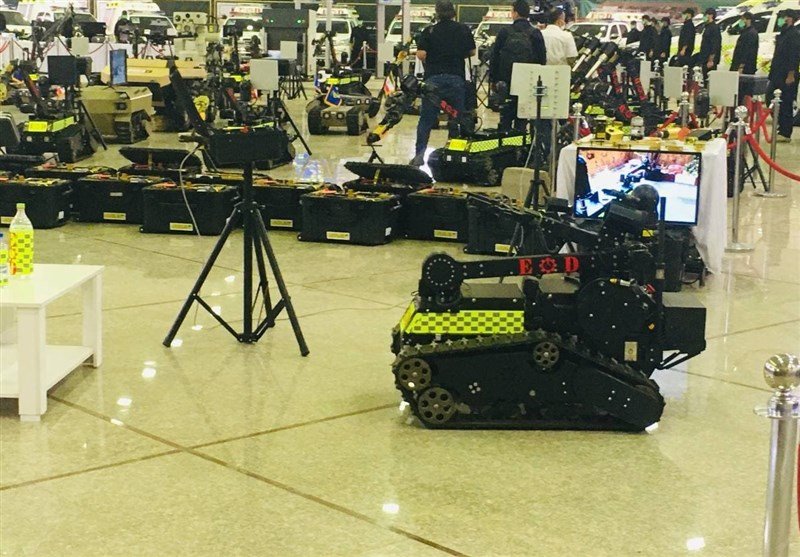
The newest UGVs of the Islamic Revolutionary Guard Corps


 IRGC has received of a batch of newest EOD UGVs and their command vehicles.


Nafez-1 EOD UGV and its carrier and command vehicles


The Qassem EOD mother UGV with its swarm UGVs. According to the Iranian sources he can guide swarm attack.


Fire fight UGV


Younes submarine robot

Some other unnamed variants


Friday, April 9, 2021

The first unit with attack robots will be created in the Russian Armed Forces.


The first unit with attack robots will be created in the Russian Armed Forces. In the near future, the military research center will work out the forms of its application. The new unit will include five Uran-9 robotic systems or 20 combat vehicles.


Saturday, March 6, 2021

South Korean Hanwha Defense MPUGV

South Korean Hanwha Defense Multi-Purpose Unmanned Ground Vehicle (MPUGV) at IDEX-2021. This was for the first time when this UGV shown in an overseas exhibition.

This electric-powered vehicle has top speed of 30km/h on paved road and has a payload capacity of 200kg for 14 hours on a single charge. Depending on the mission, operating time can be increased up to 72 hours. An upgraded 6x6 variant of the MPUGV is expected to be unveiled later this year.


Wednesday, December 30, 2020

The wheeled version of combat robot "Marker" sucesfuly tested in winter condition.

The wheeled version of combat robot "Marker" sucesfuly tested in winter condition.


According to the FPI press release, the "Marker" UGV has successfully completed the trials in autonomous mode in winter conditions. It is noted that the robotic platform covered a 30-kilometer route. In the next trials, UGV will cover 50, 100 and 200 kilometer.

Thursday, December 24, 2020

Véhicule Pommellet - One of the first robotic vehicle

The Pommellet torpedo car, developed by France before the Second World War. He's here on his transport trailer. This remotely controlled machine had the task of clearing a terrain covered with obstacles by the adversary. To do this, the Pommellet embeds a 300kg bomb. This is the camicaze vehicle. In order to guide it at night, it was surmounted by three lights. "As long as we can see the three fires, the torpedo goes straight!". The German invasion in France suspends development. It only resumed for a short time after the war.


Photo credit "Musée des Blindés"

Friday, December 4, 2020

Field Trials of the Ukrainian "Camel "Unmanned Ground Vehicles

The Ukrainian State Scientific Research Institute of Armament and Military Equipment Testing and Certification (ДНДІ ВС ОВТ) conducted a practical part of the experimental tests of the remote-controlled platform "Camel".

The Ukrainian Army has begun evaluating the new Camel tactical unmanned ground vehicle with a remote weapon station.

The Camel is an Unmanned Ground Vehicle (UGV) assisting dismounted troops with equipment transport and developed by the Ukrainian company Global Dynamics. The new UGV has a modular architecture and full compliance with the Army’s interoperability protocols makes the vehicle easy to upgrade, using a wide variety of missions kits, and keeps life cycle costs low.

Operation of the platform is easy, each wheel has its own electric engine with epitrochoid harmonic drive to ensure robust torque transmission to ensure steady footing in rough terrain and on steep slopes.

The remote control is enabled via secure radio control channel with a backup fiber-optic line. Each Camel radio system extends the reach of network coverage and allows connection of additional MESH nodes. Modular layered armor allows quick replacement of damaged parts.


Saturday, November 28, 2020

UGVs for the Korean Armed Forces

Unmanned Ground Vehicles for the Republic of Korea Armed Forces during the trials.


According to the Aju Business Daily, ROK Army select the Hyundai Rotem to provide military unmanned vehicles:

Hyundai Rotem, a subsidiary of South Korea's Hyundai auto group, was selected to provide multi-purpose unmanned vehicles capable of carrying supplies, searching battlefields and evacuating patients. Within six months, the company will supply two units and a support system for pilot operation.

Hanwha Defense UGV


Hyundai Rotem Sherpa


Tuesday, October 27, 2020

The GaardTech Jaeger-C, a smart, consumable combat UGV


Australian company GaardTech (the company specializes in robotic vehicle replicas, decoys and UGVs with some punch. ML and software for military applications), unveiled the Jaeger-C UGV whelled mine (Charge Carrier).


The GaardTech Jaeger-C, a smart, consumable combat UGV


 The Wehrmacht of 1940s are calling. They want their Charge Carrier back.


Goliath tracked mine


Tuesday, October 20, 2020

British Army Warfighting Experiment (2019-2020)

British Army new strategy places focus on cutting edge science and technology. Ground-breaking innovation will be at the heart of defence activity for generations, thanks to a bold new Science and Technology Strategy unveiled today by Defence Secretary Ben Wallace.


The Army Warfighting Experiment gives personnel the opportunity to test new and improved technologies for the next-generation of warfare.


The strategy was launched with Chief Scientific Adviser, Professor Dame Angela McLean, against a backdrop of futuristic autonomous military kit: from UAVs that can fit in the palm of a hand to crewless all-terrain surveillance vehicles commanded remotely from a Challenger II tank and the new AJAX vehicle demonstrating ‘human machine teaming’ with an unmanned all terrain buggy.

Building on the UK’s rich heritage in science and technology, this new strategy will focus on finding and funding the breakthroughs that will shape the future, and ensure the armed forces are equipped to meet tomorrow’s threats.

It will also have a renewed focus on data, including capture and curation, which will underpin research to identify threat trends and deliver generation-after-next military hardware.


Defence Secretary Ben Wallace said:
We are in a very real race with our adversaries for technological advantage. What we do today will lay the groundwork for decades to come. Proliferation of new technologies demands our science and technology is threat driven and better aligned to our needs in the future.

The pair visited Salisbury Plain ahead of the Army Warfighting Experiment (AWE), which this week will showcase some of the latest British-built military technologies.

Professor Dame Angela McLean said:
We need a clear focus on what we want science and technology to achieve. I will champion a challenge-led approach, based on trends across science, technology and the military, to set out what we need to be able to do in the future and how we can build towards it through our S&T activity.

Minister for Science Research and Innovation Amanda Solloway said:
Placing science and research at the heart of the UK’s defence activity will unleash a new wave of innovation for our brilliant armed forces, equipping them to meet our greatest challenges. By backing our best and brightest scientific minds in every corner of the UK, we will ensure we bolster the security of our nation now and for decades to come.

The Army Warfighting Experiment series allows the British Army to push the boundaries of technology and military technology, testing a range of prototype systems by putting them in the hands of the user while giving invaluable feedback to suppliers. This is all done to ensure that British troops maintain a continuous advantage over adversaries on the battlefield of today and tomorrow.

This complements the ongoing Integrated Review of foreign, defence, development and security policy. The Strategy & Technology will also be central to the government’s ambition for the UK to cement its status as a world leading science superpower, set out in its ambitious Research & Development Roadmap in July this year.


The latest strategy launch comes weeks after the MoD rolled out a new integrated operational concept to shape how Britain adapts its future military effort to the changing security threat posed by the likes of China and Russia.

Future military development would focus on five emerging technology areas that have posed the most significant enduring capability challenge, according to the new S&T strategy document. Technology areas listed are:

  • Pervasive, full-spectrum, multidomain intelligence, surveillance and reconnaissance.
  • Multidomain command and control, communications, and computers.
  • Improvement of the U.K.’s ability to compete against adversaries below the threshold of conventional conflict while addressing vulnerabilities, especially in the information environment.
  • Develop systems to target adversaries in new ways across all domains.
  • Generate affordable, survivable capabilities that can rapidly address evolving threats and can operate within a denied electromagnetic environment.
  • “They have been recognized as the key drivers for science and technology and research and development within the MoD," the document read. "The Department will continue to have an enduring requirement to maintain investment in science and technology capabilities and programs beyond these.”


Via GOV.UK

Photo credit Defence Photography