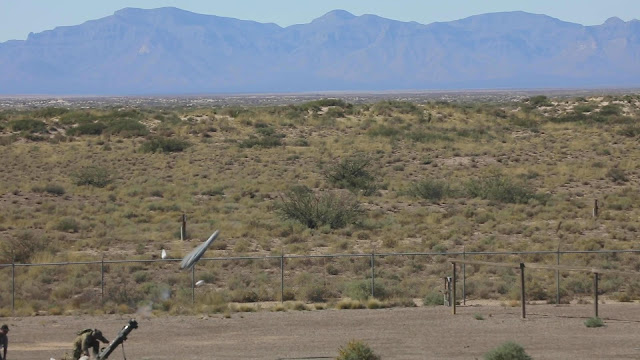
UNITED STATES - 10.07.2021 During Project Convergence 21, the Future Vertical Lift Cross-Functional Team experimented with using Air Launched Effects (ALE) to help Soldiers see the battlefield and extend their reach. Testing with Soldiers in the field allowed the FVL CFT to gain valuable feedback on this emerging capability!
Air Launched Effects (ALE) are a Family of Systems (FoS) consisting of an air vehicle, payload(s), mission system applications, and associated support equipment designed to autonomously or semi-autonomously deliver effects as a single agent or as a member of a team.
ALE is a crucial piece of the Future Armed Reconnaissance Aircraft Ecosystem advanced team concept synergistically enhancing survivability, threat identification, targeting, and lethality of Army aviation brigades and ground force commanders’ assets.
The ALE FoS extends tactical and operational reach and lethality of manned assets, allowing them to remain outside of the range of enemy sensors and weapon systems while delivering kinetic and non-kinetic, lethal and non-lethal mission effects against multiple threats, as well as, providing battle damage assessment data. They will provide scalable effects to detect, locate, disrupt, decoy, and/or deliver lethal effects against threats.
As relatively low cost systems, they are attritable or optionally recoverable. Using a Modular Open Systems Approach provides modularity and rapid integration of new technologies.
PFC Ethan Loudermilk from the 82nd Airborne Division and the civilian personell discusses training with and learning Air-Launched Effects during Project Convergence 21 at Yuma Proving Ground, Arizona.
Project Convergence is the Army's campaign of learning designed to aggressively advance and integrate our Army's contributions, based on a continuous structured series of demonstrations and experiments throughout the year. It ensures that the Army is part of the joint fight and can rapidly and continuously integrate or converge effects across all domains: air, land, sea, space, and cyberspace; to overmatch our adversaries in competition and conflict.
Project Convergence ensures the Army has the right people with the right systems, properly enabled in the right places to support the joint fight.
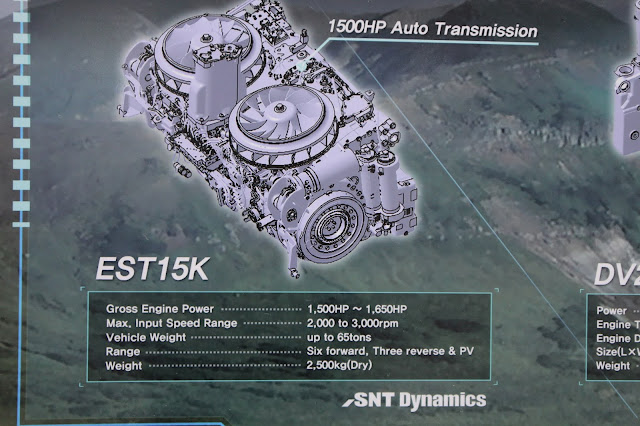
Powerpack (EST15K Auto Transmission + DV27K Engine) for MBT (K2 family). The combination of Doosan DV27K engine and SNT EST15K transmission is capable of delivering 1500 horsepower.
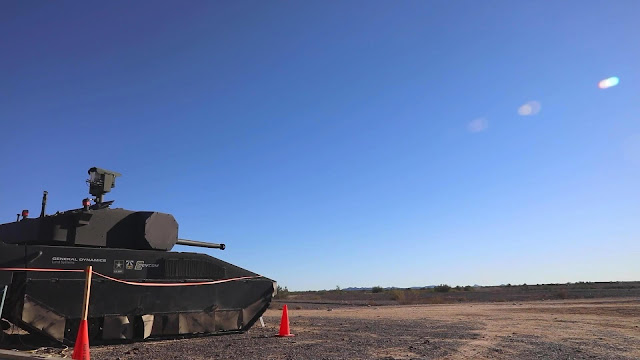
Congressman Tim Ryan Tours Joint Systems Manufacturing Center in Lima, Ohio. Ryan Recently Helped Secure $65M to Upgrade the M1 Abrams Main Battle Tank Which is Produced at the Lima Tank PlantLima, OH – Congressman Tim Ryan (OH-13), Vice Chairman of the U.S. House Defense Appropriations Subcommittee, today toured the Joint Systems Manufacturing Center in Lima, Ohio and spoke with the hardworking men and women who manufacture the Abrams tank at the plant.
The plant is currently operated by General Dynamics Land Systems and employs at least 931 people in the surrounding community. General Dynamics plays an influential role in the economy across the state, spending $187.7 million with 778 different Ohio suppliers in 2020.
The M1 Abrams is a third-generation tank that boasts several innovative features, including a multifuel turbine engine, composite armor, automated fire control system, as well as enhanced protection for its crew. The tank has been in service for over forty years.
The funding secured by Congressman Ryan will extend the service life of the tank and also integrate an unmanned turret. Additionally, it will help to develop the physical architecture and mechanical requirements needed to add an Autoloader and Automated Ammunition Handling System to the Abrams, evaluate current and emerging candidates for an Integrated Active Protection System, and develop new Abrams mobility and power architecture for conversion to a Hybrid Electric Drive propulsion and power generation system.
"State Kyiv Design Bureau "Luch", which is part of Ukroboronprom, together with Ukraine's military are conducting state tests of the Vilkha-M multiple launch rocket system at a landfill in Odesa region.
The rocket system was developed in close cooperation of the enterprises of the State Concern and Ukraine's private defense enterprises.
"Vilkha-M" is a modernization of the "Vilkha" MLRS, which was adopted into service by the Armed Forces in 2018, currently being serially produced. Modernization of the launch system is aimed at increasing the flight range and hit precision. Thus, upgraded 300 mm missiles hit ground targets at a distance of over 100 kilometers.
Tactical and technical characteristics of missiles, guidance systems and flight range were being checked during the tests. The work of MLRS and the results of the range practice on many parameters shall be evaluated by experts of the state committee. On the basis of the collected data, the commission will develop proposals to the Armed Forces of Ukraine to adopt this model in service.